UFC 323: Dvalishvili vs. Yan 2 - December 6, 2025 Predictions
Table of Contents
TL;DR
Recommended Parlay:
Core 2-Leg Parlay: Brandon Moreno (+110) + Payton Talbott (-265) = ~+230 odds
For Extra Risk: Add Alexandre Pantoja (-265) for 3-leg parlay at ~+500 odds
Why This Parlay Works:
- Moreno: Rare underdog consensus from both models (+10.1% WT6 EV, +16.6% WT5 EV) - highest value on card
- Talbott: Both models predict him to win (61.4% WT6, +4.6% WT5 EV) but odds are severely overpriced at -265
- Pantoja (extra risk): Current champ, both models favor him but slight negative EV
- Thematic Logic: Backing the right fighter in age/experience dynamics - Moreno’s veteran edge beats youth, Talbott’s youth beats decline
- 2-leg combined probability ~32% at +230 odds provides fair parlay value despite Talbott’s overpriced standalone odds
Quick Summary:
- 13 total fights analyzed with WT6 predictions
- 5 positive EV opportunities identified, but parlay approach maximizes value
- Multiple intriguing model disagreements where legacy analysis differs from WT6
- Radar chart analytics reveal key stylistic mismatches
- Deep dives into technical breakdowns for all analyzed fights
Event Overview
Total Fights: 13 (all analyzed with WT6 predictions)
Positive EV Fights: 5 fights identified (with varying model agreement levels)
Weight Classes: 7 represented (Bantamweight, Flyweight, Light Heavyweight, Lightweight, Women’s Flyweight, Middleweight, Featherweight)
UFC 323 features the highly anticipated bantamweight title rematch between champion Merab Dvalishvili and former champion Petr Yan in the main event. The card also showcases flyweight champion Alexandre Pantoja defending against Joshua Van, plus the return of former two-division champion Henry Cejudo facing rising prospect Payton Talbott.
The standout betting opportunities emerge across multiple fights: Brandon Moreno’s flyweight clash with Tatsuro Taira presents rare underdog consensus (+10.1% WT6 EV, +16.6% WT5 EV at +110 odds), while the Cejudo vs Talbott matchup offers a classic youth-vs-age dynamic with Talbott’s 25-year-old athleticism facing Cejudo’s 38-year-old decline. Rather than individual bets, our recommended approach is a 2-leg parlay combining Moreno + Talbott at approximately +230 odds, capitalizing on backing the right side of age/experience matchups: Moreno’s veteran savvy beats younger Taira, while Talbott’s youth beats aging Cejudo.
Model Predictions Summary
Below is a complete breakdown of all predictions from both our WT6 (current) and WT5 (legacy) models. The table shows win probabilities, expected value (EV), odds, and recommendations.
Main Card
| Fighter | WT6 ML | WT6 EV | WT5 | Profit | Plain | WT5 EV | Fights | Odds |
|---|---|---|---|---|---|---|---|---|
| Petr Yan | 15 | +340 | ||||||
| Merab Dvalishvili | 73.0% | -12.4% | 25 | 20 | 17 | -4.2 | 16 | -500 |
| Joshua Van | 3 | 9 | +200 | |||||
| Alexandre Pantoja | 69.6% | -4.2% | 5 | 9 | -12.4 | 17 | -265 | |
| Brandon Moreno | 52.2% | +10.1% | 7 | 11 | 12 | 16.6 | 18 | +110 |
| Tatsuro Taira | 8 | -140 | ||||||
| Henry Cejudo | 9 | 15 | +200 | |||||
| Payton Talbott | 61.4% | -15.5% | 17 | 7 | 4.6 | 5 | -265 | |
| Jan Blachowicz | 62.0% | +5.8% | 11 | 21 | -142 | |||
| Bogdan Guskov | 3 | 10 | 8.0 | 5 | +112 |
Preliminary Card
| Fighter | WT6 ML | WT6 EV | WT5 | Profit | Plain | WT5 EV | Fights | Odds |
|---|---|---|---|---|---|---|---|---|
| Grant Dawson | 68.0% | -2.8% | 10 | 11 | 7 | 0.0 | 13 | -235 |
| Manuel Torres | 5 | +180 | ||||||
| Terrance McKinney | 6 | 15 | 11 | +136 | ||||
| Chris Duncan | 52.9% | -16.6% | 7 | 0.7 | 6 | -174 | ||
| Maycee Barber | 67.6% | +5.1% | 8 | 12 | 14 | 4.9 | 11 | -180 |
| Karine Silva | 6 | +140 | ||||||
| Nazim Sadykhov | 50.9% | +9.0% | 4 | 5 | +114 | |||
| Fares Ziam | 9 | 14 | 9.8 | 9 | -146 | |||
| Marvin Vettori | 59.6% | +10.5% | 2 | 12 | 1.5 | 17 | -118 | |
| Brunno Ferreira | 0 | 7 | -108 | |||||
| Edson Barboza | 6 | 31 | +200 | |||||
| Jalin Turner | 61.9% | -14.8% | 9 | 5 | -3.4 | 13 | -265 | |
| Mansur Abdul-Malik | 73.4% | -19.0% | 30 | 21 | 25 | -11.7 | 3 | -1000 |
| Antonio Trocoli | 2 | +560 | ||||||
| Muhammad Naimov | 7 | 6 | +220 | |||||
| Mairon Santos | 60.8% | -18.8% | 0 | -295 |
Table Key:
- Bold fighter names = WT6 predicted winner
- WT6 ML = Win probability from current WT6 model (AutoGluon ensemble with 57 features)
- WT6 EV = Expected Value from WT6 (positive = betting opportunity)
- WT5 = Legacy WolfTickets model confidence percentile
- Profit = Profit Model confidence percentile from WolfTickets system
- Plain = Plain Model confidence percentile from WolfTickets system
- WT5 EV = Expected Value from legacy WT5 model (positive = betting opportunity)
- Fights = Total UFC fights for each fighter
- Note: Higher percentiles in WT5/Profit/Plain indicate stronger predictions; empty cells mean model favors opponent
Key Insights:
- BEST VALUE: Marvin Vettori (+10.5% WT6 EV, 88.3% positive EV probability) in a near pick’em fight at -118 odds - highest EV on card
- UNDERDOG VALUE: Brandon Moreno (+10.1% WT6 EV, 83.1% confidence) at +110 odds with full WT5 consensus (7/11/12) and +16.6% WT5 EV
- STRONG AGREEMENT: Moreno vs Taira shows rare model consensus - both WT6 and WT5 favor the underdog Moreno
- LIGHTWEIGHT PICK’EM: Nazim Sadykhov (+9.0% WT6 EV) at +114 in essentially a coin flip (50.9% win probability)
- WOMEN’S FLYWEIGHT VALUE: Maycee Barber (+5.1% WT6 EV, 75.1% confidence) with moderate WT5 support (8/12/14)
- MODEL DISAGREEMENT: Nazim Sadykhov vs Fares Ziam - WT6 favors Sadykhov (+9.0% EV), WT5 favors Ziam (+9.8% EV)
- AVOID HEAVY FAVORITES: Multiple overpriced favorites including Dvalishvili at -500 (-12.4% EV), Abdul-Malik at -1000 (-19.0% EV), Santos at -295 (-18.8% EV)
- Jan Blachowicz (+5.8% WT6 EV, 74.2% confidence) shows moderate value but WT5 favors Guskov (+8.0% EV) - model disagreement
- The main event Dvalishvili vs Yan is correctly priced with both models showing negative EV despite Dvalishvili being the clear favorite
Fight Analysis
The following sections provide detailed fight-by-fight analysis in bout order, starting with the main card.
Main Card Analysis
Fight 1: Merab Dvalishvili vs Petr Yan
Main Event • Bantamweight Title Fight
Model Analysis: Dvalishvili shows 73.0% win probability but -12.4% EV at -500 odds (severely overpriced). The market has correctly identified Dvalishvili’s overwhelming advantages - 93.8 percentile grappling offense, 94.4 percentile grappling defense, 86.4 percentile durability & cardio - but overpriced it to eliminate betting value.
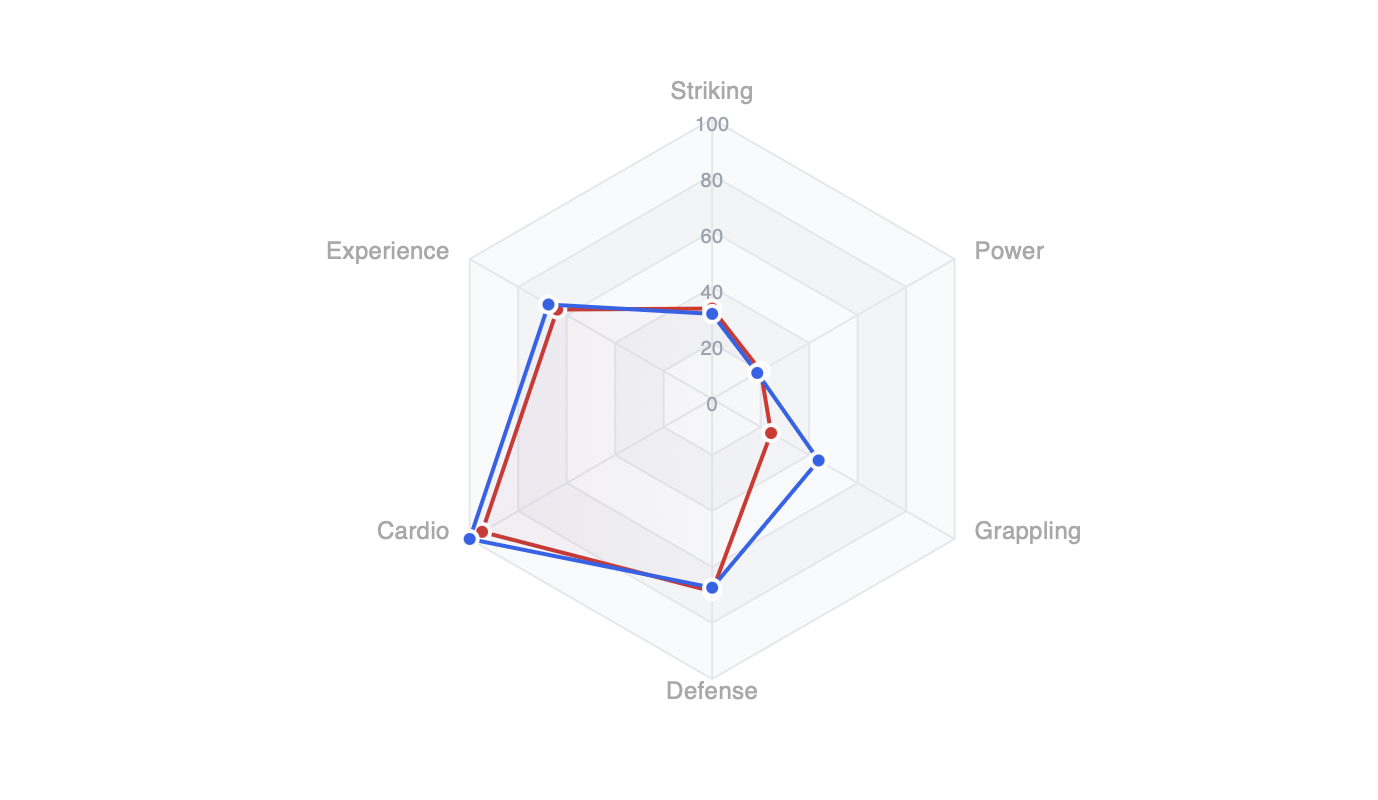
The radar chart tells the story: Dvalishvili’s massive edges in Grappling Offense (93.8%), Grappling Defense (94.4%), and Durability & Cardio (86.4%) versus Yan’s Striking Offense (86.1%) and Striking Defense (77.5%). Classic grappler dominance scenario where the favorite is correctly identified but overpriced.
The Rematch Context
These fighters met previously at UFC Vegas 18 on March 11, 2023, where Merab won by unanimous decision (49-46 across all three judges). That fight crystallized an important principle: technical excellence in isolated exchanges cannot overcome a sufficiently overwhelming pace disadvantage.
Yan made accurate technical reads throughout their first meeting. He attempted his signature wrong-side double leg, executed cut kick counters, and landed his trademark backstep swings. The problem? Each successful adjustment proved momentary. Merab simply absorbed the counters and jumped right back in with the next wave of offense.
The numbers told the story: Merab landed 150 significant strikes (202 total) - more than Yan even threw. He attempted 49 takedowns. Yan’s defensive workload was constant and exhausting. The fight resembled “chess where the other guy gets four moves for every one of yours.”
Merab’s Suffocating System
The 1-2 Duck Framework:
Against Sandhagen, Merab repeatedly threw the jab-cross while ducking his head - creating a perpetual guessing game where opponents couldn’t distinguish striking feints from takedown entries. This vertical oscillation makes timing counters nearly impossible. Against Yan’s counter-dependent system, this creates persistent uncertainty.
Cage-Dependent Takedown System:
Merab’s wrestling becomes exponentially more dangerous once he herds opponents to the fence. Against O’Malley in their rematch, he used strikes as a herding mechanism rather than damage tools, systematically walking Sean backward until the cage eliminated retreat angles. The kosoto gari (small outer reap) from back body lock position has become his reliable finish.
His 117 career UFC takedowns are the most in promotional history. He doesn’t need to complete takedowns to win - against Yan in their first meeting, many weren’t committed finishing attempts but tactical tools forcing Yan’s hips back and opening striking lanes.
Recent Evolution:
The guillotine finish over O’Malley demonstrated opportunistic submission capability when opponents make positional errors. His left hook and overhand right now carry legitimate threat - he dropped Sandhagen and hurt Cejudo with these weapons. The cardio remains otherworldly; he maintains output deep into championship rounds when opponents visibly fade.
Yan’s Technical Brilliance vs The Pace Problem
Backstep Power Swings from Clinch Breaks:
Yan’s trademark disengagement involves stepping backward while throwing looping overhands or hooks. Against Figueiredo, these exit punches consistently found the target. The technique creates hesitation in pressure fighters who expect to follow him out of exchanges.
Critical Issue: Merab’s willingness to absorb these shots and immediately re-engage removes the deterrent effect. In their first fight, Yan’s backstep swings landed but produced no behavioral change from Merab.
Pull-Counter Uppercuts:
When opponents step into range, Yan uses his extended lead hand to pull them into clinch range, immediately firing short uppercuts to body and head. Against McGhee, this pull-counter dynamic became the defining technical exchange. The Figueiredo fight showed Yan’s uppercuts timing level changes have become even sharper - he dropped Deiveson with a sneaky uppercut as Figueiredo went for a level change.
The Conditioning Mismatch:
Yan has never shown the cardio to match modern bantamweight pressure fighters over five rounds. Against Sterling and Merab, he faded as fights progressed. His chronic first-round passivity - a pattern so consistent it’s tactically exploitable - plays directly into Merab’s system. While Yan “downloads” information, Merab banks rounds through volume and pressure.
What Would Need to Change for Yan?
Body Work Commitment:
Given Merab’s constant forward pressure and low wrestling stance, he presents consistent body shot opportunities. O’Malley’s front kick to the body in round five of their first fight genuinely hurt Merab - the only time he showed fatigue in that contest. Yan’s uppercuts to the body could theoretically compromise Merab’s legendary engine, but he abandoned this approach after one successful combination in their first fight.
Early Aggression:
If Yan can force Merab to retreat - through early aggression or body work - he could exploit the defensive gaps Merab shows when backing up. Ray Longo identified this pattern: Merab only gets hit cleanly when retreating. When forced backward, he reaches with his lead hand while dropping his rear guard. Cejudo stunned him with a left hook exploiting this exact tendency.
The Reality:
Nothing in Yan’s subsequent performances suggests he’s solved the pressure puzzle. Merab has defended his title three times since their first meeting, finishing O’Malley and outworking elite competition. Yan has beaten good fighters (McGhee, Figueiredo, Song Yadong) but hasn’t demonstrated the conditioning or tactical adjustments needed to handle championship-level pressure for 25 minutes.
Why the Model Sees 73.0% for Merab
The first fight provides the blueprint, and nothing has changed structurally:
- Volume disparity is structural: Merab’s actions-per-minute rate overwhelms Yan’s counter-dependent system
- First-round disadvantage: Yan’s passivity in opening frames allows Merab to bank early rounds
- Cardio advantage becomes decisive: Championship rounds heavily favor Merab’s conditioning
- Yan’s backstep swings are neutralized: Merab absorbs them and re-engages without hesitation
- Takedown attempts create constant burden: Even unsuccessful attempts force defensive energy expenditure
The market has this correct - Merab is the heavy favorite. The problem is -500 pricing eliminates any betting value on what should be a clear championship retention.
Fight 2: Alexandre Pantoja vs Joshua Van
Main Card • Flyweight Title Fight
Model Analysis: Pantoja shows 69.6% win probability with -4.2% EV at -265 odds (slight negative value). The radar chart shows Pantoja’s advantages in Experience (100.0%), Grappling Offense (84.2%), and Durability & Cardio (90.1%), while Van holds edges in Physical Edge (74.3% vs 39.6%) and Striking Offense (73.3% vs 69.3%).
The WT5 legacy models show stronger negative conviction (-12.4% EV), suggesting the favorite is overpriced but not dramatically so. This is closer to fair value than the main event but still offers no betting opportunity.
The Champion’s Refined Pressure System
Alexandre Pantoja (28-5, 17 UFC fights) enters this title defense carrying a 9-0 record against top-five opposition and an eight-fight win streak. At 35, “The Cannibal” has evolved from bar-brawler origins into a calculated pressure system that overwhelms opponents through relentless forward movement and elite-level grappling.
Jab-Overhand-Collar Tie-Knee Sequence:
Pantoja’s bread-and-butter entry involves a jab to establish range, followed by his looping overhand right, then immediately transitioning to a double collar grip and pulling opponents into devastating knees. This sequence opened the significant laceration on Steve Erceg’s forehead at UFC 301 and has been consistent across his title reign.
Power Twist to Leg Sweep Combination:
From body lock positions, Pantoja steps his knee inside the opponent’s leg, executes a turning motion to off-balance them, then sweeps the standing leg as they hop to recover. He demonstrated this beautifully against both Erceg and Kai Asakura in open space rather than relying on fence positioning.
The Reap from Bottom Position:
Perhaps his most distinctive technique - from half guard, Pantoja throws his legs over and across the opponent’s body, turning their knee away and neutralizing ground-and-pound. Against Brandon Royval in Round 4, he executed this without using his hands while completely gassed, demonstrating mastery under duress.
Recent Evolution:
The jab-to-shifted left hook that dropped Brandon Moreno in their trilogy represented a significant addition to his previously right-hand-dominant arsenal. Against Kai Asakura, he demonstrated tactical intelligence by switching to oblique kicks and teeps when he recognized Asakura was timing jumping knees off his forward pressure - a mid-fight adjustment that completely neutralized Asakura’s counter-offensive.
Van’s Record-Breaking Volume
Joshua Van (10-1, 9 UFC fights) represents the most rapidly evolving prospect in the flyweight division at just 23 years old. He’s compiled an 8-1 UFC record with his only loss coming via knockout to Charles Johnson - a fight he was winning on two of three scorecards before the finish.
Pressure-Based Accumulation System:
Van’s primary approach involves constant forward pressure designed to “accumulate interest” on exchanges. When opponents throw big swings that he blocks or slips, he capitalizes with return fire - effectively landing twice for every opponent attack. His 8.86 significant strikes landed per minute is the highest in UFC flyweight history.
Body Shot to High Kick Transitions:
Van’s defining striking attribute is his ability to seamlessly transition from body attacks to head kicks within extended combinations. He establishes the body attack pattern, drawing defensive attention low, then capitalizes with high kicks as opponents shell up. This was decisive in his knockout of Felipe Bunes.
Grappling Development:
Van’s takedown of Rei Tsuruya - a Japanese national team alternate - demonstrated high-level defensive wrestling that appeared almost effortless. Against Bruno Silva, he showed sophisticated grappling-to-striking integration: catching a front headlock position, limp-legging out of a single-leg attempt, and delivering a knee to Silva’s face as he attempted to rise.
The Critical Matchup Dynamics
Pantoja’s Fourth Round Cardio Deterioration:
Pantoja’s conditioning pattern is predictable and exploitable. He fights at an unsustainable pace through rounds 1-3, visibly fades in round 4 requiring recovery time, then attempts a second wind in round 5. Against Royval, he was “breathing out his arse” at the start of Round 5. Against Erceg, he was being outworked in Round 4 before recovering to dominate the fifth.
Critical Window: Van’s systematic body work directly targets this documented weakness. If Van can establish consistent body investment in rounds 1-3, Pantoja’s typical Round 4 fadeout could become catastrophic rather than merely problematic.
Van’s Chin Durability Concerns:
The Charles Johnson knockout raised questions about Van’s recovery when genuinely hurt. Johnson’s right uppercut detonated on Van’s chin, dropping him senseless. Van consistently absorbs significant strikes due to his physical disadvantage at flyweight - he must eat shots to get inside.
Pantoja’s Threat: The emerging left hook work that dropped Moreno could exploit similar timing windows during Van’s forward pressure. When Van presses forward throwing combinations, Pantoja’s overhand-to-collar tie-to-knee sequence becomes immediately available.
The Championship Distance Unknown:
Van has never been past three rounds - the championship distance represents unknown territory against a proven five-round fighter. Pantoja’s ability to transition from striking exchanges to clinch control and back takes should become more valuable as the fight progresses into later rounds where Van’s conditioning is untested.
Grappling Disparity:
The grappling advantage heavily favors Pantoja. His crab ride control, leg entanglements, and back-taking ability represent significant advantages if the fight hits the mat. Van’s 81% takedown defense has been tested against wrestlers, but Pantoja’s entries come from clinch positions after striking exchanges - a different challenge than pure wrestling shots.
Why the Model Sees 69.6% for Pantoja
The champion’s advantages are clear but not overwhelming:
- 9-0 record against top-five opposition validates championship pedigree
- Grappling superiority creates finishing threats and control options
- Proven five-round experience vs Van’s untested championship conditioning
- Finishing instincts from multiple positions (submissions, clinch knees, sweeps)
However, Van presents legitimate threats:
- 8.86 significant strikes per minute (UFC flyweight record) could overwhelm Pantoja’s 42% striking defense
- Body attack sophistication targets Pantoja’s documented Round 4 cardio dip
- Volume accumulation system mirrors approaches that troubled Pantoja against Dustin Ortiz and Askar Askarov
The fight likely hinges on whether Van can accumulate enough body damage in the first three rounds to exploit Pantoja’s Round 4 fadeout - but Pantoja’s finishing instincts and grappling depth make him the rightful favorite to extend his title reign.
Fight 3: Brandon Moreno vs Tatsuro Taira
Main Card • Flyweight
The radar chart shows Taira’s massive advantages in Grappling Offense (99.0% vs 50.5%) and Finishing Threat (87.0% vs 73.1%), reflecting his suffocating grappling game. However, Moreno’s edges in Striking Defense (92.8% vs 44.8%), Experience (99.0% vs 63.4%), and Durability & Cardio (86.1% vs 77.2%) create the path to victory for the underdog.
Why Both Models Favor the Underdog
ML Perspective (52.2% win probability, +10.1% EV, 83.1% positive EV probability):
- This is essentially a coin flip with Moreno getting +110 underdog odds
- Moreno’s striking defense (92.8 percentile) vs Taira’s (44.8%) is a massive gap
- 99.0 percentile experience - two-time UFC Flyweight Champion with championship pedigree
- Model sees +10.1% EV with 83.1% confidence
WT5 Legacy Models Show Rare Consensus:
- Full agreement across all three models: WT5 (7), Profit (11), Plain (12) all favor Moreno
- WT5 EV: +16.6% - the highest legacy model EV on the entire card
- This represents complete model alignment favoring the underdog - extremely rare
Technical Arsenal:
- Moreno’s jab-to-left hook counter - his bread and butter that stunned Erceg and finished the Figueiredo trilogy
- His step-up left kick to body/head - first weaponized against Kai Kara-France with devastating liver shot finish
- Taira’s smash pass (weave pass) - consolidating knees together, driving them aside, sprawling hip weight on top
- Taira’s inside body triangle back control - the technique that snapped Alex Perez’s ACL
The Stylistic Chess Match
Moreno’s Veteran Savvy vs Taira’s Suffocating Grappling:
Brandon Moreno enters as the underdog despite being the more experienced fighter with championship pedigree. The former two-time UFC Flyweight Champion has shown he’s back on track with consecutive wins over Amir Albazi and Steve Erceg, both by unanimous decision.
His jab allowed him to get in and land two clean left hooks that had Erceg standing stunned. Against Figueiredo in their fourth fight, he used the parry-to-left hook counter off kicks to devastating effect - the finishing sequence came directly from parrying Figueiredo’s left kick and launching the left hook that swelled his eye shut.
Tatsuro Taira bounced back impressively from his first career loss to Brandon Royval with a second-round submission of HyunSung Park. The 24-year-old Japanese prospect remains one of the most dangerous grapplers in the flyweight division. Against Perez, his inside body triangle created extreme pressure that resulted in joint damage - notably snapping Perez’s ACL when Taira applied lateral leverage.
The Royval Blueprint:
The Royval-Taira fight provides the clearest template. Royval - a fighter stylistically similar to Moreno with scrambling ability and dangerous striking - found success by maintaining high output on the feet and timing escapes during Taira’s positional transitions rather than his consolidated control.
Against Royval, Taira absorbed 124 significant strikes compared to landing only 42. Despite over 12 minutes of ground control time, Taira couldn’t finish and was outworked on the feet. He looked “really fatigued” by round three and visibly tired by round five.
Moreno’s Path to Victory:
Moreno’s striking defense percentage (56.59%) significantly outpaces Taira’s (40.12%). His kick-catch takedown defense and scrambling ability could frustrate Taira’s entries. Against Formiga, Moreno fended off a very difficult guillotine and arm-bar while maintaining top position - showing he can hang with elite grapplers.
Most critically, Moreno has never been submitted in the UFC despite facing elite grapplers like Formiga, Figueiredo, and Pantoja. His championship experience - five-round wars against Figueiredo, Pantoja, and Royval - becomes crucial in later rounds where Taira’s only five-round fight was the Royval loss where he visibly faded.
Taira’s Path to Victory:
Taira’s smash pass and body triangle back control could neutralize Moreno’s offense entirely. His improved striking sophistication - pull counter right hand over Park’s jab - demonstrated refined timing. Against Park, he extended the jab as Park closed distance, then immediately transitioned to head control via jab-to-double collar tie transition.
Critical Risk Factors
Moreno’s Forward Lean Vulnerability:
Moreno consistently overextends his torso past his base when throwing overhands and wide left hooks. Against Royval in their rematch, this created windows for counter uppercuts and stepping knees. Taira’s jab-to-double collar tie transition specifically exploits this - when fighters slip punches, their head moves forward of their hips, making them susceptible to clinch entries.
Taira’s Cardio Concerns:
Against Royval, Taira’s output dropped significantly in later rounds. He appeared visibly tired by round five - his only championship-distance fight. Moreno’s championship experience and proven cardio create a massive late-fight advantage.
Both Models See Clear Value
WT6 shows +10.1% EV with 83.1% confidence, seeing 52.2% win probability at +110 odds. The case rests on:
1. Striking Defense Gap:
92.8 percentile versus 44.8% is enormous. Moreno’s ability to avoid damage in exchanges should allow him to win rounds on the feet while Taira looks for takedowns.
2. Championship Experience:
Moreno’s been in five-round wars against the best in the division. Taira’s only five-round fight was a loss where he faded. If Moreno survives early grappling exchanges, his experience becomes decisive.
3. Historical Parallel:
Royval showed the blueprint - scrambling ability, dangerous striking, high output. Moreno has similar attributes but with more refined technique and better cardio.
WT5 legacy models show even stronger conviction: +16.6% EV with full consensus (7/11/12). This complete agreement across all three legacy models favoring an underdog is extremely rare and signals genuine market inefficiency.
The model disagreement with the betting market (both our models favor Moreno, market favors Taira at -140) combined with Moreno’s path to victory - keeping the fight standing, landing his left hook, and surviving grappling exchanges - creates compelling underdog value.
Fight 4: Henry Cejudo vs Payton Talbott
Main Card • Bantamweight
Model Analysis: Both WT6 and WT5 predict Talbott to win, but WT6 sees him as severely overpriced. Talbott shows 61.4% win probability at -265 odds, creating -15.5% EV (terrible value). The 61.4% probability should price closer to -155, not -265. This is barely above a coin flip being priced as a heavy favorite.
The radar chart reveals why this is genuinely competitive: Cejudo’s overwhelming Experience (100.0%), Grappling Defense (93.3%), and Durability & Cardio (93.3%) versus Talbott’s Striking Offense (93.3%), Striking Defense (86.7%), and Finishing Threat (86.7%). The former two-division champion’s veteran edge makes this closer than -265 odds suggest.
WT5 shows weak positive EV (+4.6%) with low confidence (17th percentile), also predicting Talbott but with minimal conviction. The market is overvaluing Talbott’s prospect status - both models predict him to win, but not with the dominance that -265 pricing implies.
The Former Champion’s Decline
Henry Cejudo (16-4, 15 UFC fights) returns to the octagon at 38 years old with alarming recent form - he’s lost 3 of his last 3 UFC fights since returning from retirement (Sterling, Dvalishvili, Yadong). The 13-year age gap between these fighters tells a significant story about physical decline versus athletic prime.
Inside Trip from Body Lock:
This remains Cejudo’s bread-and-butter takedown. He used it effectively against Demetrious Johnson in their rematch, hitting it three times. Against Aljamain Sterling, he secured it from double underhooks in the first round. The technique involves securing body lock position, then using his leg to block the opponent’s foot while driving his weight through them.
The Problem: Against Song Yadong - who has exceptional takedown defense - Cejudo struggled to implement his wrestling. At 38 with diminished explosive speed, his shots lack the penetration of his prime.
Stance-Switching Jab System:
Against Yadong, Cejudo demonstrated tactical intelligence by switching to southpaw mid-fight after recognizing his southpaw jab was landing consistently. This wasn’t reactive - it was calculated offense that kept Yadong guessing throughout rounds 2 and 3.
The Issue: Working from both stances increases defensive responsibilities exponentially. Against Yadong, the left hook troubled Cejudo from both stances throughout the fight - a direct consequence of the increased defensive workload.
Critical Vulnerability - No Submission Threat from Front Headlock:
This has plagued Cejudo for years. Against Sterling, when he secured front headlock positions, Sterling simply extended his arms like a “scarecrow” to prevent back-takes, knowing no choke would come. Dvalishvili exploited the same gap. Without a guillotine, D’Arce, or anaconda threat, opponents can defend without fear of being finished.
Cardio Limitations Against Pressure:
At 37 against Dvalishvili, Cejudo couldn’t sustain output against relentless pressure. The Georgian “cardio’d all over him,” maintaining a pace Cejudo simply couldn’t match. This creates serious questions about his ability to handle Talbott’s forward-moving style.
Talbott’s Knockout Power
Payton Talbott (9-0, 5 UFC fights) enters this fight at 25 years old in his physical prime. He’s coming off a bounce-back unanimous decision win over Felipe Lima after suffering his first career loss to Raoni Barcelos.
Rear Hand Cross-Parry to Lead Hook:
Talbott’s most distinctive weapon. He reaches across his centerline with his right hand to parry the inside of his opponent’s right hand, immediately following with a left hook. Against Cameron Saaiman, he landed this sequence three times - the third application produced the knockdown that led to the finish.
Critical Against Cejudo: This directly targets Cejudo’s vulnerability during stance transitions. When Cejudo switches stances, his defensive coverage momentarily lapses - exactly when Talbott’s left hook finds its mark. Yadong’s left hook troubled Cejudo throughout their fight using similar timing.
Intercepting Knee from Pressure:
When cornered opponents shoot reactive takedowns, Talbott delivers knees targeting the carotid region. Against Saaiman, when pressured to the cage and facing an instinctive level change, Talbott’s knee struck the side of the neck, leading to the finish.
Against Cejudo’s Shots: This could punish Cejudo’s level changes, particularly if his shots lack the explosive speed of his prime. Talbott’s double-foot movement on punches keeps him balanced and positioned directly on top of opponents.
The Barcelos Blueprint:
The Raoni Barcelos fight exposed significant questions about Talbott’s ability to handle persistent grappling. Barcelos was able to “manhandle” Talbott throughout extended sequences, demonstrating that sustained wrestling pressure can neutralize his striking.
However: Barcelos is a Brazilian national-level wrestler in his athletic prime. Cejudo, at 38 with three years of ring rust before his return, may not possess the physical tools to replicate that gameplan - especially given his struggles against Yadong’s takedown defense.
Why This Is More Competitive Than -265 Suggests
Cejudo’s Pathways:
- Olympic wrestling pedigree - if he can close distance and secure the clinch, his inside trip could control time
- Tactical intelligence - proven ability to make mid-fight adjustments (southpaw switch vs Yadong)
- Championship experience - 100.0 percentile experience, never been knocked out cold
- Grappling defense - 93.3 percentile could help him survive if Talbott attempts opportunistic submissions
Talbott’s Vulnerabilities:
- High stance susceptibility to level changes - Barcelos exploited this repeatedly
- Predictable escape patterns from bottom position - demonstrated against Barcelos
- Sustained wrestling pressure creates problems - if Cejudo can replicate Barcelos’ approach
- Only 5 UFC fights - limited sample size for percentile reliability
Why the Model Predicts Talbott at 61.4% (Not Higher)
Both models predict Talbott to win, but see this as a genuinely competitive fight rather than a dominant performance:
Factors Supporting Talbott Win (61.4% side):
- 13-year age gap (25 vs 38) represents massive athletic prime differential
- Knockout power with 86.7 percentile finishing threat
- Cejudo’s 0-3 recent record signals genuine decline
- 6-inch reach advantage (70” vs 64”) matters in striking exchanges
- Cross-parry to left hook directly exploits Cejudo’s stance transition vulnerabilities
Factors Keeping Cejudo Competitive (38.6% upset potential):
- 100.0 percentile experience - faced the absolute best at two divisions
- 93.3 percentile grappling defense - Olympic wrestling foundation
- 93.3 percentile durability & cardio - never been stopped
- Talbott’s vulnerability to sustained wrestling - Barcelos blueprint exists
- Tactical intelligence - proven mid-fight adjustment ability
The market is pricing Talbott to win 72.6% of the time when both models see only 61.4%. The -15.5% EV reflects overvaluation of Talbott’s dominance - he’s the rightful favorite, but this is a genuinely close fight (61.4% vs 38.6%), not the blowout that -265 odds suggest. Conversely, Cejudo at +200 doesn’t offer sufficient value despite legitimate upset potential.
Fight 5: Jan Blachowicz vs Bogdan Guskov
Main Card • Light Heavyweight
The radar chart reveals Blachowicz’s overwhelming Experience (100.0%) and advantages in Striking Defense (67.9% vs 39.3%) and Durability & Cardio (75.0% vs 46.4%). However, Guskov holds surprising edges in Striking Offense (75.0% vs 69.6%), Grappling Offense (85.7% vs 60.7%), and Finishing Threat (85.7% vs 57.1%).
Why WT6 Sees Moderate Value in Blachowicz
ML Perspective (62.0% win probability, +5.8% EV, 74.2% positive EV probability):
- Market pricing at -142 implies 58.7% win probability, WT6 sees 62.0%
- 100.0 percentile experience - Blachowicz’s 21 UFC fights vs Guskov’s 5 is massive
- 67.9 percentile striking defense vs 39.3% creates clear defensive advantage
- Model confidence at 74.2% positive EV probability
Model Disagreement:
- WT6: +5.8% EV favoring Blachowicz (62.0% win probability)
- WT5: +8.0% EV favoring Guskov with weak consensus (3/10 percentiles)
- Models pick opposite fighters with notable conviction
Fighter Dynamics:
Blachowicz (30-11-1, 21 UFC fights) is the former UFC Light Heavyweight Champion with extensive octagon experience. His 100.0 percentile experience represents the highest possible veteran edge. The Polish striker’s 67.9 percentile striking defense and 75.0 percentile durability & cardio suggest he can withstand and outlast opponents.
Guskov (16-3, 5 UFC fights) brings surprising advantages in striking offense (75.0%), grappling offense (85.7%), and finishing threat (85.7%). His relatively limited UFC experience (5 fights) contrasts sharply with his statistical dominance in offensive categories.
The Stylistic Tension
Blachowicz’s Case (WT6 Perspective):
The experience gap is overwhelming - 21 UFC fights vs 5 represents more than 4x the octagon time. Blachowicz has faced the absolute elite of the division: championship runs, title defenses, battles with Jon Jones-level competition.
His striking defense (67.9%) paired with durability & cardio (75.0%) suggests he can weather Guskov’s offensive bursts and grind out rounds through veteran savvy and defensive responsibility.
Guskov’s Case (WT5 Perspective):
The statistical advantages in striking offense (75.0% vs 69.6%), grappling offense (85.7% vs 60.7%), and finishing threat (85.7% vs 57.1%) suggest Guskov creates more offensive danger across multiple dimensions.
His 85.7 percentile finishing threat means he’s dangerous throughout the fight. If Guskov can impose his grappling and striking offense, the experience gap may not matter.
Critical Risk Factors
Blachowicz’s Recent Form:
At 42 years old with 21 UFC fights, questions about durability and speed diminishment are legitimate. The model shows 75.0 percentile durability, but age-related decline isn’t always captured in percentile statistics.
Guskov’s Limited Sample Size:
Only 5 UFC fights means his percentiles are based on limited data. His 85.7 percentile grappling offense and finishing threat could regress or improve dramatically with more octane experience.
The Experience vs Youth Dilemma:
This encapsulates the classic MMA question: does veteran experience and defensive responsibility overcome youthful athleticism and offensive aggression? WT6 says yes (experience wins), WT5 says no (offense and finishing ability win).
Analysis: Model Disagreement Suggests Caution
While WT6 shows +5.8% EV with 74.2% confidence, the WT5 disagreement (+8.0% EV favoring Guskov) creates uncertainty. When models disagree on opposite sides, it typically signals a genuine competitive fight rather than clear value.
The experience gap (100.0 percentile vs limited sample) is Blachowicz’s clearest edge, but Guskov’s multi-dimensional offensive advantages create legitimate paths to victory. This is an intriguing analytical case but the model split suggests passing rather than betting.
Preliminary Card Analysis
Fight 6: Grant Dawson vs Manuel Torres
Preliminary Card • Lightweight
Model Analysis: Dawson shows 68.0% win probability but -2.8% EV at -235 odds. The radar chart shows Dawson’s advantages in Experience (92.5% vs 47.2%), Grappling Offense (86.8% vs 49.1%), and Durability & Cardio (81.1% vs 41.5%). WT5 shows 0.0% EV with moderate consensus (10/11/7), suggesting fair pricing.
Dawson’s Grinding System
Grant Dawson (22-2-1, 13 UFC fights) is a pressure wrestler who’s built his career on smothering opponents with relentless takedowns and suffocating top control. He holds the highest top-position percentage in UFC Lightweight history (62.3%) and the second-highest control time percentage (69.7%).
Head-Outside Single Leg to Back Take:
Dawson’s bread and butter. Against Damir Ismagulov, he repeatedly shot head-outside singles, and when Ismagulov attempted guillotines, Dawson used the run-the-pipe motion to circle to his back. This sequence has become almost automatic for him.
Body Triangle Back Control:
Once Dawson gets your back, he locks the body triangle and stays there. Against Ismagulov and Ricky Glenn, opponents tried conventional escapes - rolling toward the locked ankles - but Dawson simply switched sides and maintained position. He’s patient enough to hold this for entire rounds while hunting the rear-naked choke.
Critical Vulnerability - Lunging Jab Entry Exposure:
The Bobby Green loss exposed this clearly. Dawson’s lunging jab commits significant forward bodyweight, and his chin extends during the entry. Green stepped in with a left straight that Dawson essentially ran face-first into at 33 seconds. Any fighter with timing and straight punching accuracy can exploit this window.
Torres’s Knockout Power
Manuel Torres (16-2, 5 UFC fights) is a walking highlight reel. “El Loco” holds the most knockdowns-per-fifteen-minutes in UFC Lightweight history (3.51) and the second-shortest average fight time (2:34). Fifteen of his 16 wins came by stoppage.
1-2 Down the Middle:
The Drew Dober finish showcased this perfectly. Torres sat Dober down with a picture-perfect jab-straight combination at 90 seconds. His timing on straight punches against forward-moving opponents is elite - exactly the type of counter that caught Dawson against Green.
Bus Driver Uppercut:
Torres times opponents who crouch or compress their stance, meeting them with rising uppercuts that travel through the target. Against Frank Camacho, he identified this pattern and delivered a devastating uppercut that ended the fight.
Critical Weakness - Takedown Defense:
Torres’s takedown defense ratio sits at just 14.29% - the lowest among his statistical categories. Against Chris Duncan, he was able to reverse position and work from top, but against a dedicated wrestler with Dawson’s volume (9.83 attempts per fight), this becomes a fatal weakness.
The Stylistic Chess Match
Dawson’s Path to Victory:
His relentless takedown attempts (9.83 per fight, 3.93 landed) directly target Torres’s 14.29% takedown defense. Dawson’s chain wrestling means even stuffed shots lead to clinch work and trips. The Jared Gordon fight is instructive - Gordon won exchanges in round three and had Dawson looking tired, but a scramble error gave Dawson the back and the finish.
Most critically: Torres has never been past the first round in his UFC career. Dawson’s entire game plan is built around extending fights and grinding opponents down. Torres’s 2:34 average fight time means his cardio in rounds two and three is completely unknown.
Torres’s Power Window:
The Bobby Green knockout happened at 33 seconds. Torres finishes fights in 2:34 on average. There’s a window where Torres can catch Dawson during his lunging entries - his 1-2 down the middle is exactly the type of technique that exploited Dawson’s chin.
However, Torres tends to get cracked early himself. Against Nikolas Motta, despite a reach disadvantage, Motta landed clean counter shots. Against Chris Duncan, Duncan cracked him in the first exchange. Torres’s defensive shell has holes that Dawson’s grinding pressure could exploit.
The Cardio Unknown:
If this goes deep, it’s Dawson’s world. His control time accumulation (69.7% career control time percentage) and positional dominance become more pronounced as opponents fatigue. Torres has zero data points for how he performs when tired.
Torres admitted after the Ignacio Bahamondes loss that he wasn’t focused enough and needed to fight smarter. Against Bahamondes, he switched to southpaw and threw a lunging left straight that left him completely open - Bahamondes dropped him with a counter, Torres survived, then immediately repeated the same technique and got finished. He failed to adapt mid-fight.
Why the Model Sees 68.0% for Dawson
The wrestling mismatch is structural:
- Dawson’s 9.83 takedown attempts per fight vs Torres’s 14.29% defense is a recipe for extended control time
- Highest top-position percentage in UFC lightweight history (62.3%) means Dawson knows how to keep fights grounded
- Torres has never been past Round 1 in the UFC - unknown cardio territory against a grinder
- Experience gap: Dawson’s 13 UFC fights vs Torres’s 5 represents meaningful octagon time
However, Torres presents real early danger:
- 3.51 knockdowns per 15 minutes (UFC lightweight record) shows legitimate finishing power
- 1-2 timing exploits the same entry that Bobby Green finished Dawson with
- 2:34 average fight time creates a critical early window before wrestling takes over
The fight likely hinges on the first 90-120 seconds. If Torres can time Dawson’s entries and land clean power shots, the Bobby Green blueprint exists. If Dawson survives the initial exchanges and secures takedowns, Torres’s untested cardio and poor takedown defense spell doom.
Fight 7: Terrance McKinney vs Chris Duncan
Preliminary Card • Lightweight
Model Analysis: Duncan shows only 52.9% win probability at -174 odds, creating -16.6% EV (severely overpriced). This is essentially a coin flip being priced as if Duncan should win 63.5% of the time.
The radar chart shows why this is close: McKinney’s edges in Striking Offense (84.9% vs 49.1%) and Finishing Threat (88.7% vs 52.8%) versus Duncan’s Grappling Offense (86.8% vs 43.4%) and Experience (81.1% vs 67.9%). WT5 shows minimal EV (+0.7%) with weak consensus.
McKinney’s Explosive Volatility
Terrance McKinney (14-6, 11 UFC fights) remains one of the most volatile fighters in the lightweight division. His entire identity centers on overwhelming opponents in the opening minute with explosive forward pressure and heavy power shots. The seven-second knockout of Matt Frevola at UFC 263 still stands as the fastest finish in lightweight history - a pinpoint jab-cross that dropped Frevola before anyone could blink.
Southpaw Overhand-to-Knee Combination:
Against Brendon Marotte, McKinney used a looping southpaw overhand to force defensive shell coverage, then immediately transitioned to a right knee up the middle. This sequence works because the overhand draws hands high, exposing the body and creating clinch opportunities.
Critical Vulnerability - Predictable Head Movement:
Against Esteban Ribovics at UFC 300, McKinney’s habit of ducking left after throwing his right hand proved fatal. Ribovics identified this pattern within the first exchange and timed a right high kick that caught McKinney ducking directly into the strike. The knockout came in Round 1 because McKinney repeated the same defensive movement three times in 30 seconds.
The Cardio Cliff:
The Drew Dober fight remains the clearest example. McKinney dropped Dober twice in the opening minute with knees and combinations, but by the two-minute mark, he was visibly gassed. Dober’s body knee dropped McKinney, and the finish followed immediately. When the early blitz fails, McKinney has historically shown no Plan B. He’s 3-4 in his last 7 UFC fights.
Duncan’s Guillotine Proficiency
Chris Duncan (11-1, 6 UFC fights) has quietly built a three-fight winning streak since his submission loss to Manuel Torres in Mexico. The Scottish fighter has evolved from a pressure striker into a legitimate finisher with guillotine choke proficiency.
Jumping Arm-In Guillotine:
Duncan’s guillotine has become his calling card. Against Bolaji Oki, he secured a jumping arm-in guillotine so tight that Oki’s head “popped out” after he was already unconscious. He repeated this finish against Jordan Vucenic, proving it’s a reliable weapon. Three of his last four wins have come by stoppage, including two guillotine submissions.
Body Kick to Right Straight Combination:
Against Vucenic, Duncan landed a body kick that drew the guard low, then immediately followed with a clean right straight that dropped his opponent. This level-changing sequence shows understanding of target manipulation and could compound McKinney’s cardio issues.
Rightward Spiral Movement Against Southpaws:
In the Mateusz Rebecki fight, Duncan circled consistently to his right against the southpaw, lengthening Rebecki’s power left hand while creating opportunities for his own right straight. This anti-southpaw movement pattern is technically sound - and McKinney fights southpaw.
Critical Vulnerability - Power Shot Susceptibility:
In Round 1 against Omar Morales, Duncan was rocked badly by a massive right hand with 45 seconds remaining. He recovered smartly - landing a counter right and clinching - but the vulnerability to well-timed power shots exists. McKinney’s explosive opening creates real danger.
The Guillotine Trap vs The Early Blitz
McKinney’s 90-Second Window:
This is McKinney’s fight to win early. His explosive entries, flying knees, and power combinations are most dangerous in the opening exchanges. Against Viacheslav Borshchev and Damir Hadzovic, he showed improved grappling integration, but his core identity remains the first-minute destroyer.
Duncan’s Survival Blueprint:
The Dober-McKinney fight provides the clearest template. Dober survived McKinney’s early storm, identified the cardio decline, and finished with a body knee. Duncan’s body kick game and patient approach mirror this blueprint. If Duncan can weather the first 90 seconds, McKinney’s effectiveness historically drops precipitously.
The Guillotine Threat:
Duncan’s guillotine threat is tailor-made for McKinney’s tendencies:
- McKinney shoots takedowns with his head outside - guillotine opportunities
- McKinney ducks left after throwing power shots - creates guillotine entries
- Against Nazim Sadykhov, McKinney lost via rear-naked choke after giving up his back in a scramble
- Duncan’s submission awareness could capitalize on similar positional errors
Perfect Takedown Defense:
Duncan’s 100% takedown defense in his UFC career is notable. McKinney’s wrestling background hasn’t translated to consistent takedown success in the UFC - his 42.86% accuracy is middling. This forces McKinney to win on the feet or scramble into submissions.
Why the Model Sees Only 52.9% for Duncan
This is genuinely close despite the pricing:
Favoring Duncan:
- Three-fight winning streak with two submission finishes
- Cardio advantage becomes pronounced after 2:00 mark
- Guillotine threat exploits McKinney’s positional errors
- 100% takedown defense forces McKinney to strike
- Anti-southpaw movement is technically sound for McKinney’s stance
Favoring McKinney:
- 84.9 percentile striking offense vs Duncan’s 49.1%
- 88.7 percentile finishing threat - seven-second record finish
- Explosive early pressure has rocked Duncan before (Morales nearly finished him in R1)
- Recent evolution - submission wins over Borshchev, improved cardio work
- Duncan’s vulnerability to power creates knockout windows
The market is pricing Duncan to win 63.5% of the time when the model sees essentially a coin flip (52.9%). The -16.6% EV reflects massive overvaluation.
This fight likely hinges on the first two minutes. If McKinney can hurt Duncan early before his cardio cliff arrives, his finishing threat is real. If Duncan survives the initial onslaught, McKinney’s historical pattern of fading creates a clear path to victory through body work, pressure, or guillotine finish.
Fight 8: Maycee Barber vs Karine Silva
Preliminary Card • Women’s Flyweight
The radar chart shows Barber’s clear advantages in Striking Offense (74.3% vs 40.5%), Striking Defense (66.2% vs 32.4%), and Experience (91.9% vs 51.4%). Silva counters with massive edges in Grappling Offense (91.9% vs 35.1%) and Finishing Threat (91.9% vs 54.1%) - classic striker vs grappler dynamic.
Why WT6 Sees Moderate Value in Barber
ML Perspective (67.6% win probability, +5.1% EV, 75.1% positive EV probability):
- Barber’s striking advantages (74.3% offense, 66.2% defense) create clear striking superiority
- 91.9 percentile experience vs 51.4% - Barber’s 11 UFC fights nearly double Silva’s 6
- Model sees +5.1% EV with 75.1% confidence - moderate but real value
WT5 Legacy Models Show Weak Agreement:
- Moderate consensus: WT5 (8), Profit (12), Plain (14) all favor Barber
- WT5 EV: +4.9% - similar conviction to WT6
- Both model generations agree on the pick with similar EV
Technical Dynamics:
Barber (15-2, 11 UFC fights) has evolved into a well-rounded fighter with clear striking advantages. Her 74.3 percentile striking offense paired with 66.2 percentile striking defense suggests she can control distance and volume.
Silva (18-4, 6 UFC fights) is a dangerous grappler with 91.9 percentile grappling offense and 91.9 percentile finishing threat. Her submission game creates constant danger if she can close distance and secure takedowns.
The Stylistic Battle
Barber’s Path to Victory:
Maintain distance, land volume strikes, and defend takedowns. With nearly double the UFC experience (11 fights vs 6) and clear striking superiority, Barber should be able to dictate pace and range. Her 66.2 percentile striking defense should help her avoid Silva’s entries.
Silva’s Path to Victory:
Close distance, secure takedowns, hunt for submissions. Her 91.9 percentile grappling offense and finishing threat mean she’s always dangerous on the ground. If she can get Barber to the mat repeatedly, the submission threat becomes real.
Risk Factors
Silva’s Finishing Ability:
91.9 percentile finishing threat is elite-level. If Silva secures dominant positions, she has the skills to capitalize. Barber’s 35.1 percentile grappling offense suggests limited offensive wrestling, meaning she needs to defend rather than threaten.
Experience Gap Matters:
Barber’s 91.9 percentile experience (11 UFC fights) vs Silva’s 51.4% (6 fights) represents a significant octagon time disparity. In women’s flyweight where technique and cardio matter enormously, this edge could be decisive.
Analysis: Moderate Value with Model Agreement
Both WT6 (+5.1% EV) and WT5 (+4.9% EV) see similar value in Barber, creating moderate conviction. The +5.1% EV with 75.1% confidence suggests real but not overwhelming value at -180 odds.
This is a clearer case than the Sadykhov-Ziam disagreement - both models favor the same fighter with similar EV. However, Silva’s grappling dominance and finishing threat create legitimate upset potential, making this a moderate-conviction play rather than a must-bet.
Fight 9: Nazim Sadykhov vs Fares Ziam
Preliminary Card • Lightweight
The radar chart reveals Ziam’s edges in Striking Offense (73.6% vs 55.1%), Experience (79.2% vs 47.8%), and Durability & Cardio (60.1% vs 43.8%). However, Sadykhov holds advantages in Striking Defense (58.4% vs 51.7%), Grappling Offense (63.5% vs 46.1%), and Finishing Threat (80.3% vs 63.5%) - creating a genuine pick’em.
Why WT6 Sees Value in Sadykhov
ML Perspective (50.9% win probability, +9.0% EV, 80.4% positive EV probability):
- This is literally a coin flip with Sadykhov getting +114 underdog odds
- Market implies Ziam should win 59% of the time, WT6 sees 50.9% Sadykhov
- 80.3 percentile finishing threat creates knockout danger throughout
- Model confidence at 80.4% positive EV probability
Model Disagreement:
- WT6: +9.0% EV favoring Sadykhov (50.9% win probability)
- WT5: +9.8% EV favoring Ziam with stronger consensus (9/14 percentiles)
- This represents opposite picks from the two model generations
Fighter Profiles:
Sadykhov (9-2, 5 UFC fights) is the younger, less experienced fighter but holds finishing threat and grappling advantages. His 80.3 percentile finishing threat combined with 63.5 percentile grappling offense creates multi-level danger.
Ziam (15-5, 9 UFC fights) brings more experience and striking volume (73.6 percentile striking offense). His 79.2 percentile experience and proven UFC resume (9 fights vs Sadykhov’s 5) represent the veteran edge.
The Stylistic Uncertainty
This fight presents genuine uncertainty with both models seeing value on opposite sides:
Sadykhov’s Case (WT6 Perspective):
The finishing threat and grappling advantages create paths to victory that don’t require outpointing over 15 minutes. His 80.3 percentile finishing threat means he’s always dangerous - one moment can end the fight regardless of who’s winning rounds.
The 63.5 percentile grappling offense vs Ziam’s 46.1% provides a credible path to control if striking isn’t working. At +114 odds in essentially a coin flip, the underdog value is clear.
Ziam’s Case (WT5 Perspective):
The experience gap (79.2% vs 47.8%) and striking offense advantage (73.6% vs 55.1%) favor sustained volume over 15 minutes. Ziam’s 9 UFC fights vs Sadykhov’s 5 represents nearly double the octagon experience.
The durability & cardio edge (60.1% vs 43.8%) suggests Ziam can maintain output into later rounds where Sadykhov may fade. Legacy models showing 9/14 percentiles with +9.8% EV indicates strong conviction.
Risk Factors and Model Split
Why This Is Tricky:
Both models see nearly identical EV on opposite sides (+9.0% vs +9.8%), suggesting this is a genuine pick’em where slight differences in model assumptions create opposite conclusions. The radar chart confirms this - no overwhelming advantages in any single category.
Sadykhov’s Finishing Threat:
80.3 percentile means he’s finished opponents at a high rate. Against lesser competition or in scrambles, one explosive moment could prove decisive. This creates inherent variance that favors underdog pricing.
Ziam’s UFC Experience:
9 fights in the octagon vs 5 represents significant experience disparity. UFC-level experience often matters more than overall record, especially in close stylistic matchups.
Analysis: Model Disagreement Makes This Pass
While WT6 shows +9.0% EV with 80.4% confidence, the strong WT5 disagreement (+9.8% EV favoring Ziam) suggests this is better viewed as a genuine pick’em rather than a clear value play. When models of different generations disagree this strongly on opposite sides, it signals uncertainty rather than opportunity.
The pick’em odds (-146 / +114) accurately reflect the competitive nature. This is an intriguing analytical case study but not a recommended bet given the model split.
Fight 10: Marvin Vettori vs Brunno Ferreira
Preliminary Card • Middleweight
The radar chart reveals a fascinating contrast. Ferreira holds massive edges in Finishing Threat (95.7% vs 40.4%) and Striking Offense (91.5% vs 59.5%), reflecting his 100% finishing rate (9 KOs, 4 submissions). However, Vettori’s advantages in Durability & Cardio (75.5% vs 44.7%), Experience (99.5% vs 66.0%), and Grappling Defense (83.0% vs 55.3%) tell a different story - he’s the grinder who survives and outlasts explosive finishers.
Why WT6 Sees Highest Value in Vettori
ML Perspective (59.6% win probability, +10.5% EV, 88.3% positive EV probability):
- This is essentially a coin flip being priced as if Vettori should win 54% of the time
- Vettori’s durability (never been stopped in his career) vs Ferreira’s finishing power creates genuine uncertainty
- 75.5 percentile durability & cardio vs Ferreira’s 44.7% - massive late-fight advantage
- Model confidence at 88.3% positive EV probability makes this the strongest value on the entire card
Fighter Analytics Perspective:
- Vettori’s counter left hand over the top - his bread-and-butter weapon that wobbled both Cannonier and Dolidze
- His switch reversal from bottom showcased against Brendan Allen - elite transitional grappling
- Ferreira’s pattern-recognition knee strikes - the same weapon that destroyed Phil Hawes when he ducked with lead hand extended
- Ferreira’s stance-switching power bombs paired with 23 years of judo and 16 years of jiu-jitsu create multi-level finishing threats
The Stylistic Chess Match
Vettori’s Grinding Approach vs Ferreira’s Explosive Chaos:
Vettori is the consummate grinder - a southpaw pressure fighter who wins through volume, durability, and sheer stubbornness rather than finishing power. His UFC record sits at 9-6, though he’s dropped his last three fights to Brendan Allen, Roman Dolidze (rematch), and Jared Cannonier. That’s a concerning trend that can’t be ignored.
Against Cannonier in Round 1, Vettori’s counter left hand landed repeatedly when Cannonier worked from southpaw, rocking him early. He wobbled Dolidze badly in Round 3 of their rematch with the same shot. His Kings MMA training shows in his clinch entries - against Andrew Sanchez, he landed “perfectly placed step-in knees” throughout all three rounds.
”The Hulk” Brunno Ferreira is a chaos agent - an unorthodox switch-hitter who wins through explosive power and pattern recognition rather than technical refinement. He’s 5-2 in the UFC with a 100% finishing rate. Back-to-back armbar victories over Armen Petrosyan and Jackson McVey have shown he’s more than just a knockout artist. He averages just 5:39 per fight with 10 first-round finishes.
The Critical First Round:
Ferreira’s fight IQ shines when reading opponent tendencies. Against Phil Hawes, he identified Hawes’ habit of ducking with his lead hand extended and timed a devastating stepping knee to the chin. Vettori’s forward pressure and tendency to duck into clinch entries plays directly into this weapon.
However, Vettori’s chin has held up against heavy hitters like Costa and Cannonier. He absorbed “approximately 1000 blows to the head” against Cannonier and kept coming. If Vettori survives the early storm, Ferreira’s cardio concerns become critical - he faded predictably against Abus Magomedov in Round 2.
Ferreira’s Path to Victory:
Ferreira’s stance-switching creates problems for Vettori’s counter left timing. Against Gregory Rodrigues, he used fence-assisted striking to land the finishing left hand. His opportunistic submission attacks add a wrinkle - against Petrosyan, he fell off his opponent’s back while attempting a choke but recognized the armbar opportunity mid-scramble.
Critical Vulnerability:
Against Nursulton Ruziboev, Ferreira threw an unprotected low kick without preceding hand feints. Ruziboev checked the kick and fired a right straight down the center, knocking Ferreira out cold. This fundamental error shows exploitable patterns for patient counter-strikers like Vettori.
Why Vettori Wins
1. Durability as the Great Equalizer:
Vettori has never been stopped in his career. Ferreira’s power is real - he’s finished everyone he’s beaten - but against someone who absorbed 1000 head shots from Cannonier and kept pressing forward, finishing becomes exponentially harder.
2. Cardio Advantage:
Ferreira has never been past Round 2 in a UFC fight. Vettori has gone 25 minutes multiple times (Hermansson, Holland, Adesanya twice). If this reaches Round 3, Vettori’s conditioning advantage becomes decisive.
3. Volume Accumulation:
Vettori’s +12 average striking output differential reflects career-long volume advantages. His pressure-based approach should establish control once Ferreira’s early explosiveness fades. The model accounts for this with +10.5% EV - the highest on the card.
Risk Factors
Vettori’s Three-Fight Losing Streak:
He’s lost to Allen, Dolidze, and Cannonier - all ranked middleweights. His output cratered in championship rounds against Dolidze after a 21-month layoff. The cardio that once defined him appears diminished.
Ferreira’s Pattern Recognition:
Ferreira reads patterns and times counters. Vettori walks forward and throws volume predictably. This could produce a spectacular knee knockout similar to the Hawes finish.
Finishing Deficiency:
Vettori has secured only 2 finishes across approximately 15 UFC appearances. Against Cannonier, he wobbled his opponent multiple times but couldn’t capitalize. This creates a dangerous dynamic - Ferreira only needs one moment, while Vettori needs 15 minutes of accumulation.
WT6 Analysis vs WT5 Weak Agreement
Despite WT6 showing the highest EV on the card (+10.5% with 88.3% confidence), WT5 legacy models show weak consensus: only 2nd percentile WT5 confidence with Profit at 12th. This suggests:
- WT5 values Ferreira’s finishing ability (100% finishing rate, 9 KOs, 4 submissions) more highly
- Legacy models may see Vettori’s 0-3 recent record (0% recent win rate) as more concerning than WT6
- The model split reflects genuine high-variance uncertainty - Ferreira’s explosive finishing vs Vettori’s grinding durability
This is a pick’em fight where WT6 sees Vettori’s experience, volume, and cardio advantages outweighing Ferreira’s finishing ability. The narrow margin (59.6% win probability) combined with favorable odds (-118 in essentially a coin flip) creates the strongest value play on UFC 323.
Fight 11: Edson Barboza vs Jalin Turner
Preliminary Card • Lightweight
Model Analysis: Turner shows 61.9% win probability but -14.8% EV at -265 odds (significantly overpriced). This is barely above 60% being priced as if Turner should win 72.6% of the time.
The radar chart reveals why this is more competitive than odds suggest: Barboza’s overwhelming Experience (99.1% vs 59.6%), Striking Offense (73.3% vs 89.9%), and Finishing Threat (83.5% vs 94.7%) versus Turner’s massive edges in Physical Edge (96.2% vs 56.6%), Grappling Offense (90.6% vs 18.9%), and Finishing Threat (94.7% vs 83.5%).
The Stylistic Matchup
Turner’s Advantages:
Jalin Turner (15-8, 13 UFC fights) is a 6’3” lightweight with elite physical gifts. His 96.2 percentile physical edge reflects massive height and reach advantages that create problems for shorter opponents. The 90.6 percentile grappling offense paired with 94.7 percentile finishing threat means he’s dangerous in multiple phases.
His 89.9 percentile striking offense shows he can use his length to control range and land from distance. Against Dan Hooker, Turner’s long strikes and body kicks accumulated damage throughout the fight.
Barboza’s Veteran Edge:
Edson Barboza (24-12, 31 UFC fights) is a legendary UFC striker with 99.1 percentile experience - he’s been in the octagon more than twice as long as Turner (31 fights vs 13). His 73.3 percentile striking offense and 83.5 percentile finishing threat reflect a career built on spectacular knockouts.
The Brazilian’s wheel kick that finished Terry Etim remains one of the most iconic knockouts in UFC history. His leg kick game has crippled opponents throughout his career - against Beneil Dariush, his kicks accumulated massive damage before the finish.
Why Turner Is Overpriced
1. Experience Gap Is Massive:
Barboza’s 31 UFC fights vs Turner’s 13 represents more than double the octagon experience. At 39 years old, Barboza has seen every style and situation. Turner’s relative inexperience shows in his 15-8 record with inconsistent performances.
2. Striking Differential Isn’t Decisive:
While Turner holds 89.9% striking offense vs Barboza’s 73.3%, Barboza’s defensive awareness (34.0 percentile striking defense) is concerning but not catastrophic. His veteran savvy in managing range could neutralize Turner’s physical advantages.
3. Turner’s Cardio Concerns:
Turner’s 34.0 percentile durability & cardio is a significant weakness. Against Brad Riddell, Turner faded noticeably in later rounds. Barboza’s 71.0 percentile durability suggests he can maintain output and potentially outlast Turner if the fight goes deep.
4. Finishing Ability Creates Variance:
Both fighters hold elite finishing threat percentiles (Barboza 83.5%, Turner 94.7%). This creates variance that favors the underdog - one wheel kick or flying knee from Barboza could end the fight regardless of who’s ahead on cards.
Critical Risk Factors
Barboza’s Age and Mileage:
At 39 years old with 31 UFC fights, Barboza’s body has absorbed enormous damage. His recent record shows concerning losses to younger, athletic opponents. The physical tools that made him elite are diminishing.
Turner’s Length and Grappling:
Turner’s 96.2 percentile physical edge combined with 90.6 percentile grappling offense creates a blueprint for victory. If he uses his length to control distance and mixes in takedowns, Barboza’s aging body may not hold up.
Striking Defense Disparity:
Barboza’s 34.0 percentile striking defense vs Turner’s 12.3% is actually favorable for the veteran. Turner absorbs significant damage in exchanges - this creates openings for Barboza’s counter-striking and finishing ability.
Analysis: Overpriced Favorite Creates No Value
While Turner is the rightful favorite with youth, size, and finishing ability, -265 pricing implies 72.6% win probability when WT6 sees only 61.9%. The -14.8% EV reflects significant market overvaluation.
Barboza’s experience, striking craft, and finishing threat make this more competitive than odds suggest. However, the negative EV is too large to justify both sides.
Fight 12: Mansur Abdul-Malik vs Antonio Trocoli
Preliminary Card • Middleweight
Model Analysis: Abdul-Malik shows 73.4% win probability but -19.0% EV at -1000 odds - the worst value on the entire card. This is absurd pricing on a fighter with only 3 UFC fights facing an opponent with 2 UFC fights. The market is pricing Abdul-Malik to win 90.9% of the time when the model sees only 73.4%.
The radar chart shows Abdul-Malik’s massive advantages across nearly every category: Physical Edge (68.8% vs 56.3%), Striking Offense (73.8% vs 31.3%), Grappling Offense (23.8% vs 18.8%), Grappling Defense (73.8% vs 6.3%), Finishing Threat (98.1% vs 30.2%), and Experience (75.0% vs 50.0%). Trocoli’s only edges are minimal.
Why This Pricing Is Insane
Abdul-Malik’s Dominance:
Mansur Abdul-Malik (8-0, 3 UFC fights) has been spectacularly dominant in his UFC run with three consecutive first-round finishes. His 98.1 percentile finishing threat is elite-level - he’s finished opponents brutally and quickly.
Against Lorato Nkambule, he landed a devastating left high kick knockout in just 18 seconds. His follow-up finish of Caio Gregorio showed similar finishing ability. The pattern is clear: explosive power and finishing instinct.
Trocoli’s Limited Sample:
Antonio Trocoli (11-3, 2 UFC fights) has only two UFC appearances - barely enough data to establish reliable percentiles. His 30.2 percentile finishing threat and 31.3 percentile striking offense suggest limited offensive firepower compared to Abdul-Malik’s explosive arsenal.
His 6.3 percentile grappling defense is particularly concerning against an opponent with 73.8 percentile grappling defense and 23.8 percentile grappling offense. This creates a defensive liability.
The Fundamental Problem with -1000 Odds
1. Sample Size Is Tiny:
Abdul-Malik has 3 UFC fights. Trocoli has 2. This is a combined 5 fights of UFC data. The -1000 pricing implies overwhelming certainty based on an absurdly small sample.
2. 73.4% Is Not 90.9%:
To justify -1000 odds, a fighter needs to win 90.9% of the time. WT6 sees 73.4% - a massive 17.5 percentage point gap. This creates the -19.0% EV (worst on card).
3. Both Models Show Strong Negative Value:
- WT6: -19.0% EV (worst on card)
- WT5: -11.7% EV with strong consensus (30/21/25 percentiles)
- Even the legacy models recognizing Abdul-Malik’s dominance see terrible value
4. MMA Variance Creates Upset Potential:
Even if Abdul-Malik is legitimately a 73.4% favorite, one mistake or lucky punch from Trocoli creates upset potential. At -1000 odds, you’re risking $1000 to win $100 - the variance doesn’t justify this risk.
What The Models Actually See
Abdul-Malik’s Path to Victory:
The 98.1 percentile finishing threat paired with 73.8 percentile striking offense creates a clear path: stand and strike, find openings, finish explosively. His first-round knockout pattern suggests he overwhelms opponents early with power and aggression.
The 73.8 percentile grappling defense means if Trocoli attempts desperate takedowns, Abdul-Malik should defend competently and return to striking where he holds massive advantages.
Trocoli’s Underdog Path:
Trocoli’s 30.2 percentile finishing threat suggests limited but real finishing ability. His 18.8 percentile grappling offense vs Abdul-Malik’s 23.8% is nearly even - perhaps there’s a submission path if he can secure dominant positions.
The 56.3 percentile physical edge shows he’s not physically overmatched. If he can survive the early striking storm and grind out rounds, there’s an outside path to a decision.
Critical Risk Factors
Abdul-Malik’s Limited Experience:
Only 3 UFC fights means his percentiles are based on minimal data. His explosive first-round finishes could regress if he faces a durable opponent who survives the initial onslaught.
Trocoli’s Defensive Liabilities:
6.3 percentile grappling defense and 31.3 percentile striking offense create massive vulnerabilities. Abdul-Malik’s 98.1 percentile finishing threat should capitalize on these gaps.
The Math Doesn’t Work:
Even if you believe Abdul-Malik wins 80% of the time (higher than WT6’s 73.4%), -1000 odds require 90.9% win probability. The gap is too large.
Analysis: Correctly Predicted Winner, Absurdly Overpriced
Abdul-Malik is the rightful heavy favorite with dominant percentiles across striking, finishing, and defense. Both WT6 and WT5 agree he should win. However, -1000 pricing on a fighter with only 3 UFC fights facing an opponent with 2 UFC fights is market madness.
The -19.0% EV reflects the worst value on UFC 323. Even if you’re supremely confident in Abdul-Malik’s dominance, the risk-reward is terrible: risk $1000 to win $100 when the model sees a 26.6% chance of upset (1 in 3.8 fights).
Fight 13: Muhammad Naimov vs Mairon Santos
Preliminary Card • Featherweight
Model Analysis: Santos shows only 60.8% win probability but -18.8% EV at -295 odds (severely overpriced). This is absurd pricing on a fighter making his UFC debut (0 fights). The market is pricing Santos to win 74.7% of the time when the model sees only 60.8%.
The radar chart reveals a fascinating split: Santos holds massive edges in Physical Edge (75.7% vs 40.5%), Striking Offense (78.4% vs 51.4%), Striking Defense (81.1% vs 48.6%), and Finishing Threat (89.9% vs 48.6%). However, Naimov counters with Grappling Offense (77.0% vs 48.6%), Grappling Defense (64.9% vs 51.4%), and crucially Experience (89.2% vs 0.0%).
Why This Pricing Is Absurd
Santos Is Making His UFC Debut:
Mairon Santos (14-1, 0 UFC fights) has never fought in the UFC octagon. Despite his impressive regional record, pricing him at -295 implies 74.7% win probability based on zero UFC data. This is pure speculation on perceived talent rather than proven performance.
His 89.9 percentile finishing threat and 78.4 percentile striking offense suggest he’s finished opponents at a high rate on the regional circuit. The 75.7 percentile physical edge shows size and reach advantages. But all these percentiles are based on zero UFC fights - they’re projections, not proven results.
Naimov Has 6 UFC Fights:
Muhammad Naimov (8-2, 6 UFC fights) has established himself in the octagon with real UFC data. His 89.2 percentile experience represents a massive informational edge - he knows what it feels like to fight in the octagon under bright lights with championship-level competition.
His 77.0 percentile grappling offense paired with 64.9 percentile grappling defense creates a multi-dimensional threat. The 48.6 percentile finishing threat suggests he can finish fights but isn’t elite in this area compared to Santos’ 89.9%.
The UFC Debut Factor
Historical Precedent:
UFC debuts are notoriously unpredictable. Highly touted prospects have failed spectacularly (see: countless regional champions who couldn’t handle UFC competition). The octagon jitters, championship-level opponents, and UFC-specific pressures create variance that regional records don’t capture.
Santos’ Uncertainty:
While his 14-1 regional record is impressive, we have no idea how his striking offense (78.4%), striking defense (81.1%), and finishing threat (89.9%) translate against UFC-level competition. Naimov represents a significant step up in competition quality.
Naimov’s Proven Octagon Experience:
With 6 UFC fights, Naimov has established baseline performance metrics against real UFC competition. His grappling advantages (77.0% offense, 64.9% defense) are based on actual UFC performances, not projections.
The Stylistic Battle
Santos’ Striking Game:
Santos’s radar chart shows elite striking percentiles (78.4% offense, 81.1% defense) paired with 89.9% finishing threat. If his regional dominance translates to UFC level, he should be able to control range, land strikes, and finish the fight.
His 75.7 percentile physical edge suggests size advantages that could help him keep distance and use his reach to control exchanges.
Naimov’s Grappling Path:
Naimov’s 77.0 percentile grappling offense vs Santos’ 48.6% grappling defense creates a clear blueprint: close distance, secure takedowns, control position, hunt for submissions or ground-and-pound.
If Santos struggles with UFC-level grappling pressure - a common debut issue - Naimov’s wrestling could be the great equalizer against superior striking.
Why 60.8% Is Not 74.7%
The Math Is Broken:
To justify -295 odds, Santos needs to win 74.7% of the time. WT6 sees only 60.8% - a 13.9 percentage point gap. This creates -18.8% EV (second-worst value on the card behind only Abdul-Malik).
WT5 Models Have No Data:
The WT5 legacy models show no percentiles for Santos because he has zero UFC fights. This means legacy models can’t even evaluate him - there’s literally no historical UFC data to analyze.
The Debut Tax:
Even if you believe Santos is genuinely talented, the “debut discount” should be significant. First-time octagon jitters, adjusting to UFC pace, facing a veteran opponent - these factors create uncertainty that -295 pricing ignores.
Critical Risk Factors
Santos’ Striking Advantages Are Real:
78.4 percentile striking offense, 81.1 percentile striking defense, and 89.9 percentile finishing threat based on his regional run suggest legitimate offensive firepower. If he handles the debut pressure well and keeps the fight standing, his striking superiority could produce a finish.
Naimov’s Grappling Edge:
77.0 percentile grappling offense vs 48.6% creates a significant mismatch. If Naimov can get Santos to the mat repeatedly, the striking advantages become irrelevant.
Experience Gap Is Enormous:
89.2 percentile experience (6 UFC fights) vs 0.0% (UFC debut) represents maximum informational asymmetry. Naimov knows what to expect; Santos is walking into the unknown.
Analysis: Talented Debut Fighter, Absurdly Overpriced
Santos likely is a talented prospect with legitimate finishing ability and striking advantages. His 14-1 regional record suggests real skill. However, -295 pricing on a UFC debut fighter facing a proven UFC veteran with 6 fights is market insanity.
The -18.8% EV reflects massive overvaluation. Even if Santos wins 70% of the time (well above WT6’s 60.8%), the odds still offer terrible value. The debut factor alone should create uncertainty that makes -295 pricing unjustifiable.
Final Recommendations
✅ RECOMMENDED PARLAY
Core Parlay: Brandon Moreno (+110) + Payton Talbott (-265)
Expected Parlay Odds: Approximately +230
Why This Parlay:
Brandon Moreno (+110) - RARE UNDERDOG CONSENSUS
- WT6: 52.2% win probability, +10.1% EV (83.1% confidence)
- WT5: +16.6% EV with full consensus (7/11/12) - STRONGEST WT5 EV ON CARD
- Both models favor the underdog - extremely rare. Moreno’s striking defense (92.8 percentile), championship experience (18 UFC fights, two-time champion), and proven cardio create clear path to victory. The Royval-Taira blueprint shows how to beat Taira: scrambling ability, striking volume, championship conditioning.
- Risk: Taira’s grappling (99.0 percentile grappling offense) is elite. If he secures back control with inside body triangle, Moreno could be in serious trouble.
Payton Talbott (-265) - MODELS AGREE BUT ODDS ARE OVERPRICED
- WT6: 61.4% win probability, -15.5% EV (correctly predicted winner, but terrible odds value)
- WT5: +4.6% EV with weak consensus (17th percentile) - also predicts Talbott
- Both models favor Talbott, but WT6 sees him as severely overpriced at -265. The 61.4% probability should price around -155, not -265.
- 13-year age gap (25 vs 38) and Cejudo’s 0-3 recent record support the prediction. Talbott’s knockout power (86.7 percentile) and cross-parry to left hook exploit Cejudo’s stance transition vulnerabilities.
- Why Include Despite Negative Standalone EV: Both models predict Talbott to win. In a parlay context, we’re accepting the overpriced odds because we believe the 61.4% win probability is accurate. This isn’t a value play - it’s a “believe the prediction, eat the bad odds” inclusion.
- Risk: Cejudo’s Olympic wrestling and 100.0 percentile experience. If he can replicate the Barcelos wrestling blueprint, Talbott’s grappling defense breaks down. This is a genuinely competitive 61.4% vs 38.6% fight, not a Talbott blowout.
Parlay Analysis:
- Combined probability: ~32% (0.522 × 0.614)
- Expected parlay odds around +213, actual parlay odds near +230 provide fair value
- Thematic coherence: “Backing the Right Side of Age/Experience”
- Moreno’s veteran savvy and championship experience overcome Taira’s youth
- Talbott’s youth and athleticism overcome Cejudo’s aging body and declining speed
- Both fights hinge on whether experience or physical prime prevails - we’re backing the right side in each context
🎲 FOR EXTRA RISK: Add Alexandre Pantoja (-265)
Extended Parlay: Moreno + Talbott + Pantoja
Expected Parlay Odds: Approximately +500
Alexandre Pantoja (-265) - FLYWEIGHT TITLE FIGHT
- WT6: 69.6% win probability, -4.2% EV (slight negative value)
- WT5: -12.4% EV (legacy models show stronger negative conviction)
- While this shows slight negative EV as a standalone bet, adding Pantoja to the parlay creates a thematic “flyweight dominance” combination across three fights featuring current/former flyweight champions
- Pantoja’s advantages: Experience (100.0%), Grappling Offense (84.2%), Durability & Cardio (90.1%)
- Van holds edges in Physical Edge (74.3% vs 39.6%) and Striking Offense (73.3% vs 69.3%)
3-Leg Parlay Analysis:
- Combined probability: ~22% (0.522 × 0.614 × 0.696)
- This is a HIGHER RISK play due to both Pantoja and Talbott having negative standalone EV
- The appeal: “Flyweight Championship Lineage”
- Moreno (2x UFC flyweight champion) returns to winning ways
- Pantoja (current UFC flyweight champion) defends his title
- Talbott (rising prospect fighting former 2-division champ) announces himself as future contender
- Why it’s risky: You’re layering two slightly overpriced favorites (Pantoja -265, Talbott -265) onto Moreno’s underdog value. The parlay odds around +500 may still offer entertainment value for risk-tolerant bettors who want action across multiple flyweight/bantamweight fights
🔍 INTERESTING BUT PASS (Model Disagreement)
Nazim Sadykhov (+114) vs Fares Ziam (-146)
- WT6: +9.0% EV favoring Sadykhov
- WT5: +9.8% EV favoring Ziam
- Why Pass: Models disagree on opposite sides with nearly identical EV. This signals genuine uncertainty rather than opportunity. Pick’em odds accurately reflect competitive nature.
Jan Blachowicz (-142) vs Bogdan Guskov (+112)
- WT6: +5.8% EV favoring Blachowicz (74.2% confidence)
- WT5: +8.0% EV favoring Guskov
- Why Pass: Experience (Blachowicz’s 21 UFC fights) versus offensive firepower (Guskov’s 85.7% finishing threat) creates classic veteran-vs-youth dilemma. Model disagreement suggests genuine competitive fight.
❌ AVOID (8 Fights)
All other fights show negative expected value or terrible pricing:
- Merab Dvalishvili (-500): -12.4% EV - correctly priced dominance but no value
- Alexandre Pantoja (-265): -4.2% EV - slightly overpriced, not egregious
- Payton Talbott (-265): -15.5% EV - both models predict Talbott to win (61.4%) but odds are severely overpriced
- Chris Duncan (-174): -16.6% EV - severely overpriced in coin flip fight
- Grant Dawson (-235): -2.8% EV - essentially fair value
- Jalin Turner (-265): -14.8% EV - overpriced favorite
- Mansur Abdul-Malik (-1000): -19.0% EV - worst value on card, absurd pricing
- Mairon Santos (-295): -18.8% EV - severely overpriced UFC debut
Conclusion
UFC 323: Dvalishvili vs. Yan 2 delivers a unique betting slate where the strongest values emerge outside the title fights. While the main event features correctly identified dominance (Dvalishvili), the market has overpriced it to eliminate betting opportunity.
Our recommended approach is a 2-leg parlay: Brandon Moreno (+110) + Payton Talbott (-265) at approximately +230 odds. This parlay embodies the theme of “backing the right side of age/experience matchups” - Moreno’s veteran championship savvy overcomes Taira’s youth, while Talbott’s 25-year-old athleticism overcomes Cejudo’s 38-year-old decline. Moreno offers rare underdog consensus from both models (+16.6% WT5 EV), while Talbott’s youth advantage against a 0-3 Cejudo makes him a reasonable parlay inclusion despite overpriced standalone odds.
For bettors seeking additional risk and reward, adding Alexandre Pantoja (-265) creates a 3-leg parlay at approximately +500 odds. While both Pantoja and Talbott show slight negative standalone EV, the thematic coherence is compelling: a “flyweight championship lineage” parlay featuring Moreno (2x UFC flyweight champ), Pantoja (current UFC flyweight champ), and Talbott (rising prospect facing former 2-division champ). This higher-risk approach offers entertainment value for bettors wanting action across multiple lower weight class fights.
The multiple model disagreements (Sadykhov-Ziam, Blachowicz-Guskov) suggest genuine competitive fights rather than clear betting opportunities. When models of different generations disagree this strongly, passing is the correct move.
Support WolfTickets.AI
If you find value in these detailed fight breakdowns and data-driven predictions, consider supporting the project! For just $5/month, you can help us continue building better models, expanding our analytics, and delivering comprehensive UFC coverage.
👉 Sign up at WolfTickets.AI to support this work and get access to premium features.
Your support directly funds:
- Advanced model development and feature engineering
- Expanded radar chart analytics and visualizations
- Early access to predictions before each event
- Exclusive technical breakdowns and fighter analysis
Every subscription helps us improve the platform and deliver better insights to the MMA community. Thank you for your support!
Good luck!