UFC Fight Night: Royval vs. Kape - December 13, 2025 Predictions
Table of Contents
TL;DR
Top Betting Opportunity:
PARLAY: Kevin Vallejos (-320) + Gillian Robertson (-184) - Combined odds ~-105
This two-fight parlay combines the card’s highest confidence prediction (Vallejos 76.0% WT6 ML) with strong positive expected value (Robertson +4.9% WT6 EV, +10.4% WT5 EV). While Vallejos carries negative EV individually at -320, his 76.0% win probability is the highest on the card with strong model agreement (WT5: 17 percentile). Pairing him with Robertson creates a balanced play that captures Vallejos’s elite winning chances while leveraging Robertson’s underpriced grappling dominance.
Why This Parlay Works:
- Vallejos vs Chikadze: Pressure boxing vs declining kickboxer with documented wrestling deficiencies. Vallejos represents the exact fighter profile that has repeatedly dismantled Chikadze (Kattar, Allen, Onama).
- Robertson vs Lemos: Elite grappling (92% percentile) vs exposed takedown defense (56%). Robertson’s 7 UFC submission wins target Lemos’s biggest weakness.
- Combined Probability: 51.7% (0.76 × 0.68) at roughly -105 odds represents positive expected value on the parlay.
Quick Summary:
- 7 total fights analyzed with both WT6 and WT5 model predictions
- Featured parlay combines highest confidence pick with strong value play
- Three overpriced favorites to avoid individually (Kape, Brito)
- Radar chart analytics reveal key grappling and stylistic mismatches
- Main event features chaos (Royval) versus precision (Kape) with genuine uncertainty
Event Overview
Total Fights: 7 (all analyzed with WT6 predictions)
Weight Classes: 4 represented (Flyweight, Women’s Strawweight, Women’s Flyweight, Featherweight, Heavyweight)
UFC Fight Night: Royval vs. Kape brings flyweight fireworks to the forefront with Brandon Royval’s controlled chaos meeting Manel Kape’s knockout power in the main event. The card features a compelling women’s strawweight co-main between power striker Amanda Lemos and submission specialist Gillian Robertson (7 UFC submission wins).
The card’s depth shines in the featherweight division with three compelling matchups: the pick’em battle between Melquizael Costa and Morgan Charriere, Joanderson Brito’s pressure meeting Melsik Baghdasaryan’s one-dimensional kicking game, and veteran Giga Chikadze facing pressure boxer Kevin Vallejos.
At heavyweight, Kennedy Nzechukwu’s timing knees face BJJ legend Marcus Buchecha’s poor MMA wrestling integration. The women’s flyweight opener pits Jamey-Lyn Horth’s range kicking against Tereza Bleda’s grappling-heavy approach.
Model Predictions Summary
Below is a complete breakdown of all predictions from both our WT6 (current) and WT5 (legacy) models. The table shows win probabilities, expected value (EV), odds, and recommendations.
Main Card
| Fighter | WT6 ML | WT6 EV | WT5 | Profit | Plain | WT5 EV | Fights | Odds |
|---|---|---|---|---|---|---|---|---|
| Brandon Royval | 5 | 6 | 11 | +230 | ||||
| Manel Kape | 62.0% | -7.9% | 8 | -6.4 | 9 | -310 | ||
| Amanda Lemos | 2 | 14 | +142 | |||||
| Gillian Robertson | 68.0% | +4.9% | 14 | 3 | 10.4 | 19 | -184 |
Preliminary Card
| Fighter | WT6 ML | WT6 EV | WT5 | Profit | Plain | WT5 EV | Fights | Odds |
|---|---|---|---|---|---|---|---|---|
| Melquizael Costa | 55.0% | +4.2% | 6 | 13 | 20 | 9.1 | 7 | -113 |
| Morgan Charriere | 5 | -113 | ||||||
| Marcus Buchecha | 1 | +112 | ||||||
| Kennedy Nzechukwu | 59.0% | +0.4% | 6 | 9 | 21 | 3.5 | 14 | -142 |
| Joanderson Brito | 70.0% | -6.7% | 14 | 9 | 3 | 0.2 | 8 | -300 |
| Melsik Baghdasaryan | 5 | +240 | ||||||
| Giga Chikadze | 3 | 3 | 11 | +235 | ||||
| Kevin Vallejos | 76.0% | -5.8% | 17 | 1.0 | 2 | -320 | ||
| Jamey-Lyn Horth | 8 | 10 | 5 | +126 | ||||
| Tereza Bleda | 54.0% | -3.7% | 4 | -1.7 | 2 | -162 |
Table Key:
- Bold fighter names = WT6 predicted winner
- WT6 ML = Win probability from current WT6 model (AutoGluon ensemble with 57 features)
- WT6 EV = Expected Value from WT6 (positive = betting opportunity)
- WT5 = Legacy WolfTickets model confidence percentile
- Profit = Profit Model confidence percentile from WolfTickets system
- Plain = Plain Model confidence percentile from WolfTickets system
- WT5 EV = Expected Value from legacy WT5 model (positive = betting opportunity)
- Fights = Total UFC fights for each fighter
- Note: Higher percentiles in WT5/Profit/Plain indicate stronger predictions; empty cells mean model favors opponent
Key Insights:
- FEATURED PARLAY: Vallejos (-320) + Robertson (-184) at ~-105 combined odds - pairs highest confidence pick (76.0% WT6 ML) with strong positive EV (+4.9% WT6, +10.4% WT5) for balanced value
- HIGHEST CONFIDENCE: Kevin Vallejos (76.0% WT6 ML, WT5: 17) - best inclusion for parlay due to overwhelming stylistic advantage despite individual negative EV
- POSITIVE EV COMPONENT: Gillian Robertson (+4.9% WT6 EV, +10.4% WT5 EV) - high WT5 percentile (14) supports grappling-heavy approach as parlay anchor
- ALTERNATE VALUE: Melquizael Costa (+4.2% WT6 EV, +9.1% WT5 EV) shows strong model agreement in pick’em at -113 with WT5 consensus (6/13/20)
- MODEL DISAGREEMENT: Royval vs Kape - WT6 favors Kape but WT5 shows split support (Profit: 5, Plain: 6 for Royval) suggesting uncertainty
- AVOID AS FAVORITES: Kape (-310, -7.9% WT6 EV), Brito (-300, -6.7% WT6 EV) carry excessive risk at heavy favorite prices
- CLOSE CALL: Bleda vs Horth - Low confidence (54% WT6 ML) with negative EV suggests genuine coin flip
Featured Parlay Breakdown
Vallejos + Robertson (-105 Combined)
This parlay strategically combines the card’s most dominant matchup with an underpriced grappling mismatch:
Leg 1: Kevin Vallejos (-320) vs Giga Chikadze
- WT6 Confidence: 76.0% win probability (highest on card)
- WT5 Support: 17 percentile confirms model agreement
- Stylistic Certainty: Pressure boxing vs declining kickboxer with exposed wrestling (Onama, Kattar, Allen all dominated)
- Risk Assessment: Chikadze is 36 years old, 3-4 in last 7, visibly slower with poor takedown defense
Leg 2: Gillian Robertson (-184) vs Amanda Lemos
- WT6 Edge: 68.0% win probability with +4.9% EV
- WT5 Consensus: +10.4% EV with 14 percentile (high confidence)
- Grappling Mismatch: Robertson’s 92% grappling percentile vs Lemos’s 56% takedown defense
- Path to Victory: Robertson’s 7 UFC submission wins target Lemos’s documented submission vulnerability
Combined Analysis:
- Joint Probability: 51.7% (0.76 × 0.68)
- Parlay Odds: Approximately -105
- Expected Value: Positive when combining Vallejos’s certainty with Robertson’s underpriced line
- Correlation Risk: Low - different weight classes, different fight dynamics, minimal shared variance
Why Not Individual Bets?
- Vallejos at -320 carries -5.8% WT6 EV individually (overpriced despite high win probability)
- Parlaying captures his elite winning chances while Robertson’s positive EV creates overall value
- The combined -105 price properly reflects joint 51.7% probability with upside
Fight Analysis
The following sections provide detailed fight-by-fight analysis in bout order, starting with the main card.
Main Card Analysis
Fight 1: Brandon Royval vs Manel Kape
Main Event • Flyweight
Model Analysis: Kape shows 62.0% win probability but offers negative expected value at -310 odds (-7.9% WT6 EV, -6.4% WT5 EV). Both models agree Kape is overpriced despite favoring him to win. Interestingly, the WT5 legacy models show split support with Profit (5) and Plain (6) models giving Royval small percentiles, suggesting this matchup carries genuine uncertainty. The market has correctly identified Kape’s power advantage and improved consistency, but overpriced it relative to Royval’s chaos factor.
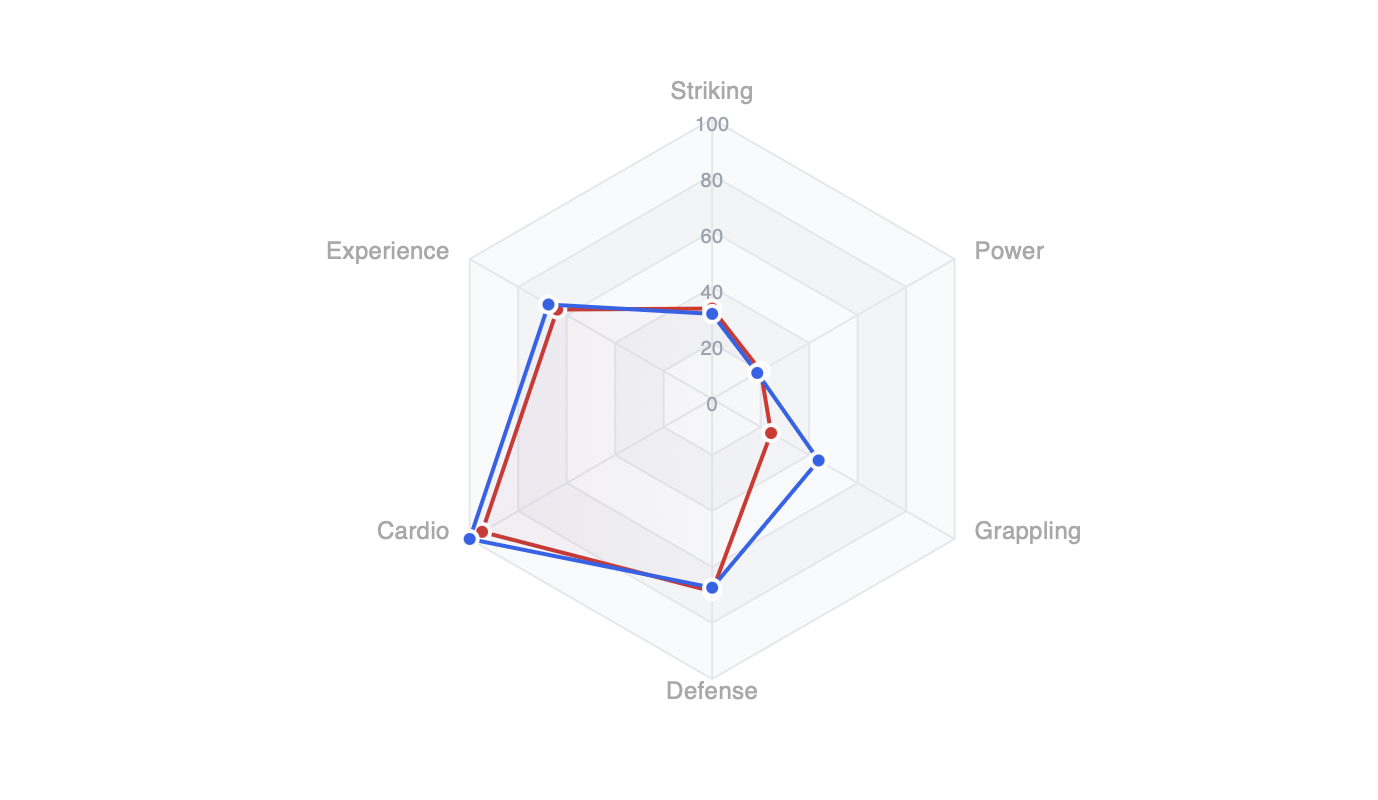
The radar chart reveals the stylistic clash: Royval’s massive edges in Grappling Defense (62%), Durability & Cardio (85%), and Experience (88%) versus Kape’s overwhelming Finishing Threat (92%) and Striking Offense (88%). This is chaos versus precision incarnate.
Royval’s Controlled Mayhem
Brandon Royval brings Factory X-trained chaos to every fight. Against Tatsuro Taira in October 2024, he outlanded the undefeated prospect 165-73 in significant strikes while surviving over 12 minutes of back control—then reversed a takedown in Round 5 to secure the split decision. His signature weapons include:
Stepping Knees: The Andy Hug comparisons are apt. Against Matheus Nicolau, a stepping knee caught Nicolau ducking into the strike for a brutal KO.
K-Guard to Leg Attacks: His modern jiu-jitsu shines from bottom position. Against Matt Schnell, he transitioned from omoplata threats to calf slicer sweeps to a Gordon Ryan-style guillotine finish.
Southpaw Switch with Left Straight: Against Joshua Van and Charles Johnson, he found success circling off angle and timing forward pressure with the left straight.
Royval has evolved recently, adopting a more measured approach. Against Brandon Moreno in February 2024, he utilized his length advantage with range strikes and timed counter uppercuts, earning a split decision over a former champion.
Royval’s Vulnerabilities
Takedown Defense When Kicking: The blueprint exists. Moreno demonstrated it—kick Royval’s inside leg knowing he’ll return a high kick, then step in for the takedown while he’s on one leg. Taira exploited this repeatedly.
Back Control Susceptibility: Despite his active guard, elite back-takers give him nightmares. Pantoja submitted him with an RNC by locking a body triangle. Taira logged nearly 9 minutes of combined back control across Rounds 2 and 4.
Kape’s Dangerous Precision
Manel Kape is the flyweight division’s most dangerous knockout artist when he shows up ready to fight. Against Asu Almabayev in March 2025, he used southpaw stance switching and left straights to set up a third-round finish. His signature techniques include:
Stance Switching to Left Straight: Against Bruno Silva in December 2024, Kape stepped back from orthodox to southpaw and hammered Silva with the left straight as he stepped forward.
Flying Knee: The Ode Osbourne finish at UFC 265 saved his UFC career—a perfectly timed flying knee caught Osbourne walking forward.
Counter Uppercuts: Against Matheus Nicolau, Kape’s uppercuts discouraged level changes and nearly turned the tide.
Kape has shown improved consistency lately. Against Dvorak, he dominated with creative combinations, secured a near-finishing kimura from bottom, and showed adaptability when taken down.
Kape’s Vulnerabilities
Susceptibility to Kicks When Level Changing: Pantoja exposed this—circling and attacking legs and body while Kape bent over to change levels.
Inconsistent Output: When he’s passive, he loses rounds he shouldn’t. Against Mokaev, he had chances but never got going.
Spinning Attack Timing: Against Dvorak, both takedowns Kape conceded came when he threw spinning techniques.
The Matchup
This is fascinating chaos versus precision. Royval wants to march forward, throw volume, and create scrambles where his submission game shines. Kape wants to counter, time entries, and land fight-ending power.
Kape’s left straight versus Royval’s forward pressure: Royval’s marching style plays into Kape’s counter-striking strengths. When Royval throws stepping knees and spinning attacks, he gives Kape exactly what he wants—forward movement to time with power counters.
Grappling exchanges: If this hits the mat, it’s complicated. Royval’s guard is active and dangerous—he threatens leg locks, gogoplatas, and guillotines constantly. Kape showed against Dvorak he can attack submissions from bottom too.
Championship experience: Royval has proven championship-round durability. His Round 5 reversal against Taira demonstrated veteran savvy. Kape has never been in a five-round UFC fight. If this goes deep, Royval’s experience and cardio become significant factors.
Recommendation: AVOID at -310 odds. While both WT6 and WT5 favor Kape, both show negative EV (-7.9% and -6.4% respectively). The WT5 split support (Profit: 5, Plain: 6 for Royval) suggests this isn’t the dominant performance the odds imply. Kape’s power makes him the rightful favorite, but Royval’s chaos and championship experience create too much uncertainty for the price. If Kape’s counters don’t land early, Royval’s volume and scrambling ability could steal rounds.
Fight 2: Amanda Lemos vs Gillian Robertson
Co-Main Event • Women’s Strawweight
Model Analysis: Robertson shows 68.0% win probability with positive expected value at -184 odds (+4.9% WT6 EV, +10.4% WT5 EV). Strong model agreement makes this one of the clearest plays on the card. The WT5 model’s high confidence percentile (14) combined with supportive Plain model (3) creates a rare consensus between legacy and current systems. The radar chart tells the complete story: Robertson’s Grappling Offense (92%) and Grappling Defense (78%) overwhelm Lemos’s Striking Offense (85%) and Finishing Threat (88%).
Lemos’s Power Striking
Lemos carries legitimate knockout ability. Against Montserrat Conejo Ruiz, she needed just 35 seconds to land a chopping right that put her opponent face-down. Against Livinha Souza at UFC 259, she dropped a former Invicta champion twice en route to a first-round TKO—one of only four women in UFC history to score multiple knockdowns in a single fight.
Her Muay Thai background shows in her Thai clinch work. Against Mizuki, she latched onto the plum position and delivered damaging knees when the Japanese fighter pressed forward.
But Lemos has a glaring problem: elite grapplers eat her alive. Zhang Weili took her down six times in their title fight. Virna Jandiroba submitted her with an armbar after taking her back. Jessica Andrade caught her in a standing arm triangle.
Her recent form is concerning: 1-2 in her last 3 UFC fights, with losses to Suarez (decision) and Jandiroba (submission).
Lemos’s Critical Vulnerabilities
Wide Right Hand Creating Takedown Entries: Lemos overcommits on her power shots, swinging wide and leaving herself open for body lock takedowns. Against Zhang in Round 2, she came out swinging her right hand and Zhang stepped in, grabbed her, and smashed her directly to side control—no guard passing necessary.
Takedown Defense Deterioration: Her 56% takedown defense rate is mediocre, and it gets worse as fights progress. She couldn’t stop Jandiroba’s decisive takedown in Round 2 despite knowing it was coming.
Robertson’s Submission Mastery
Gillian Robertson holds the UFC record for most submission wins by a woman (7). Her grappling is relentless—she shoots takedowns constantly, works patient positional advancement, and hunts finishes from everywhere.
Her back-take game is particularly dangerous. Against Priscila Cachoeira, she took the back and immediately got her hand under the throat, beginning the choke before even establishing hooks—a technique she credits to coach Din Thomas. Against Molly McCann, she put her completely unconscious with a rear-naked choke so tight McCann never tapped.
Her recent run is impressive: 4 straight wins including finishes of Polyana Viana (TKO), Marina Rodriguez (TKO), and submission victories showing improved ground-and-pound.
The Grappling Mismatch
Robertson’s relentless takedown pressure directly targets Lemos’s biggest weakness. Lemos’s wide swinging punches—the same ones Zhang exploited for body lock entries—will create openings for Robertson’s level changes.
The key question is whether Robertson can survive the early exchanges. Lemos has genuine knockout power, and Robertson has been hurt by pressure strikers before (Maycee Barber TKO’d her in Round 1). But Robertson’s recent striking improvements—using step-up low kicks to set up takedowns rather than shooting from range—give her better tools to close distance safely.
Once the fight hits the mat, the advantage shifts dramatically. Lemos’s 56% takedown defense and history of being controlled by grapplers suggests Robertson will find her way to top position. From there, Robertson’s patient positional advancement and submission hunting should dominate.
Recommendation: FEATURED PARLAY LEG at -184 odds. The strong model agreement (+4.9% WT6 EV, +10.4% WT5 EV) with WT5’s high confidence (14 percentile) makes this an ideal parlay component. Robertson’s grappling should overwhelm Lemos, and both systems agree there’s value here. Robertson averages 2.74 takedowns per fight; Lemos defends only 56% of attempts. If Robertson survives the first 2-3 minutes, she should control and potentially finish. The WT5 consensus adds conviction. Pairs perfectly with Vallejos in the featured parlay.
Preliminary Card Analysis
Fight 3: Kennedy Nzechukwu vs Marcus Buchecha
Preliminary Card • Heavyweight
Model Analysis: Nzechukwu shows 58% win probability (6/20 confidence) with small positive expected value at -142 odds. The radar chart reveals a fascinating juxtaposition: Buchecha’s Grappling Offense (95%) is elite, but his Striking Offense (28%), Striking Defense (39%), and Durability & Cardio (45%) create massive vulnerabilities. Nzechukwu’s Physical Edge (78%), Reach advantage, and Finishing Threat (85%) should dominate if this stays standing.
Nzechukwu’s Timing and Power
Kennedy Nzechukwu brings legitimate heavyweight power and a 6-inch reach advantage (83” vs 77”) into this matchup. The “African Savage” has shown he can finish fights at any moment, with knockouts over Lukasz Brzeski and Chris Barnett in his recent heavyweight run.
Timing Knees Against Level Changes: Nzechukwu’s most devastating weapon. Against Ion Cutelaba at UFC Vegas 65, he was getting dominated in Round 1 before timing a perfect flying knee as Cutelaba shot for a takedown. A second knee sent Cutelaba into the fence for the finish at 1:02 of Round 2. This technique is tailor-made for a grappler like Buchecha.
Right Hook from Southpaw Stance: His finishing blow against Carlos Ulberg came from a perfectly placed right hook along the cage.
Clinch Elbows: In his UFC debut against Paul Craig, Nzechukwu landed “Travis Browne style elbows” that opened a nasty cut. When grapplers shoot on him, he punishes them with short elbows and knees.
Nzechukwu has shown improved composure at heavyweight. Against Cutelaba, he weathered a brutal first round—including getting mounted—before rallying for the finish.
Nzechukwu’s Vulnerabilities
Leg Lock Defense: His most recent loss came via heel hook to Valter Walker at UFC 317. Walker secured a back body lock despite a poor initial takedown, then transitioned to fifty-fifty position for the finish. Buchecha’s elite BJJ credentials make this a concern.
Slow Starts and Passive Tendencies: Against Ovince Saint Preux, Nzechukwu was “completely tepid for two rounds,” losing a split decision. His slow start could give Buchecha early opportunities.
Buchecha’s BJJ Credentials Meet MMA Reality
Marcus Buchecha is a legitimate grappling legend—13-time BJJ world champion with multiple ADCC titles. His credentials on the mat are beyond question. The problem? Those skills haven’t translated to MMA.
His takedown accuracy sits at a brutal 9.09%—landing just 1 of 11 attempts in his last fight against Martin Buday. Against Buday, he was “shooting out in the open and falling down onto his face.” He lacks the chain wrestling to finish singles against the fence or set up entries with strikes.
Despite being a back-take specialist, Buchecha couldn’t maintain the position against Buday. One attempt saw him slide over the top with his head bonking into the mat—described as “how Batman dispatches a goon who’s jumped on his back.”
His physical conditioning has been questioned, and at heavyweight, gassing out against a power puncher like Nzechukwu would be catastrophic.
The Mismatch
This matchup heavily favors Nzechukwu’s skill set. Buchecha’s poor open-space takedowns mean he’ll likely shoot from distance. Nzechukwu has proven he can time knees against level changes—the Cutelaba finish is the blueprint.
Buchecha’s 9% takedown accuracy against Nzechukwu’s 77% takedown defense (recent) suggests the Brazilian will struggle to get this fight to the mat.
Buchecha’s only realistic path is catching Nzechukwu in a leg entanglement similar to Walker’s heel hook finish. His BJJ is elite enough that one mistake on the mat could end the fight.
This mirrors Nzechukwu’s fight against Danilo Marques, a Demian Maia protégé with elite BJJ. Marques rode Nzechukwu’s back for 4:30 in Round 1 but couldn’t finish. When Marques gassed from his grappling efforts, Nzechukwu blitzed him with combinations for a 20-second Round 3 TKO.
Recommendation: MARGINAL VALUE at -142 odds. Nzechukwu’s timing knees, reach advantage, and proven finishing power at heavyweight make him the clear favorite. The small positive EV (+0.4% WT6, +3.5% WT5) with WT5 consensus (6/9/21) suggests slight value. The only concern is Buchecha catching a leg entanglement, but getting there requires wrestling Buchecha hasn’t demonstrated. Consider for those seeking additional action beyond the featured parlay.
Fight 4: Melquizael Costa vs Morgan Charriere
Preliminary Card • Featherweight
Model Analysis: Costa shows 55.0% win probability with positive expected value at -113 odds (+4.2% WT6 EV, +9.1% WT5 EV). This is the cleanest value on the card with strong model agreement. The WT5 consensus (6/13/20 across WT5/Profit/Plain models) is particularly compelling—all three legacy models favor Costa with meaningful percentiles. When both the current WT6 system and the legacy WT5 suite agree with positive EV in a pick’em fight, it signals a genuine market inefficiency. The radar chart reveals the decisive advantage: Costa’s Grappling Offense (75%), Grappling Defense (72%), and Finishing Threat (80%) overwhelm Charriere’s alarming Grappling Defense (20%) weakness.
Costa’s Four-Fight Streak
Costa enters riding a four-fight winning streak that has transformed him from a guy who got finished by Thiago Moises into a legitimate featherweight contender. The Brazilian southpaw has developed into a well-rounded threat with dangerous jiu-jitsu and increasingly polished striking.
Osoto Gari (Outside Leg Reap): Against Julian Erosa in Round 3, Costa walked up, planted his lead foot outside Erosa’s, slapped him in the head as a distraction, and swept him so smoothly it looked like Erosa pulled guard. This traditional throw gives Costa a reliable way to put opponents on the mat when clinch battles develop.
Guillotine from Butterfly Guard: Against Andre Fili, Costa demonstrated elite patience with this choke. When Fili timed a body kick and secured a takedown into body lock position, Costa wrapped the neck slowly, methodically removing space until Fili had to tap before it even looked like Costa was squeezing. This submission threat makes opponents pay for sloppy entries.
Body Kicks from Southpaw: Costa’s left body kicks are his primary striking weapon. He throws them with volume and they accumulate damage.
Costa’s defensive improvements have been dramatic. Against Erosa, he spent most of the fight with his back on the cage but maintained crisp striking and solid defense throughout.
Charriere’s Kickboxing Credentials and Fatal Flaw
The Frenchman is a technically clean striker who just secured a third-round stoppage over Nate Landwehr. Charriere brings legitimate kickboxing credentials from Cage Warriors and has shown surprising grappling competence.
Calf Kicks: Charriere uses these to establish range and damage the lead leg early. Against Landwehr, his calf kicks forced Landwehr to adjust his entries and start using false steps to avoid them.
Counter Left Hook from Clinch Exit: Against Gabriel Miranda, Charriere demonstrated elite transitional awareness, landing a short left hook that caught Miranda completely blind as he completed an uchi mata spin.
But here’s the fatal flaw: Charriere’s 20% takedown defense ratio is alarming. While he can scramble and recover, he struggles to stop initial entries. Against a submission specialist like Costa, getting taken down repeatedly could be catastrophic.
The Critical Mismatch
Charriere’s output under pressure: When faced with relentless forward movement, Charriere tends to throw less and shell up defensively. Against Landwehr, he was “the victim of not throwing enough” in the second round despite landing harder when he did engage.
Costa’s guillotine threat: If Charriere shoots without proper head position—like Fili did—he could find himself in a choke. Costa doesn’t rush submissions; he methodically removes space like he did against Fili.
Charriere’s lack of knockout power: He’s not a single-shot knockout artist. Against Nathaniel Wood, he lost partly because “he had no urgency” when behind on the scorecards. When he needs to turn a fight around, he lacks the power to do it with one shot.
Costa doesn’t need to finish—he can grind out a decision using clinch work, judo throws, and top control. His four-fight streak includes quality wins over Julian Erosa, Christian Rodriguez, and Andre Fili—he’s beaten finishers and grapplers alike.
Recommendation: ALTERNATE VALUE at -113 odds. This represents the cleanest value on the card with remarkable model agreement. Both WT6 (+4.2% EV) and WT5 (+9.1% EV) show positive expected value, and the WT5 consensus (6/13/20) across all three legacy models is rare and valuable. When current and legacy systems align with positive EV in a pick’em fight, it’s a clear market inefficiency. Costa’s grappling advantage against Charriere’s 20% takedown defense creates a clear path to victory. Costa attempts over 5 takedowns per fight, and if Charriere gives up his neck on a wrestling entry, this fight ends early. An excellent option for those wanting additional action beyond the featured parlay.
Fight 5: Joanderson Brito vs Melsik Baghdasaryan
Preliminary Card • Featherweight
Model Analysis: Brito shows 70% win probability (14/20 confidence) but offers significant negative expected value at -300 odds. The radar chart shows Brito’s Striking Offense (82%), Finishing Threat (85%), and Grappling Offense (48%) advantages versus Baghdasaryan’s one-dimensional approach reflected in weak Grappling Offense (25%) and Grappling Defense (40%).
Brito’s Pressure and Finishing Ability
Brito enters this fight off back-to-back losses—a split decision to William Gomis and a unanimous decision to Pat Sabatini. But context matters here. Those losses came against a wrestler (Sabatini) and a point-fighter (Gomis). Baghdasaryan is neither—he wants to stand and trade.
Calf Kicks as Primary Weapon: Against Jack Shore, Brito built his entire offense around relentless calf kicks while backing Shore to the fence. The doctor’s stoppage came from shin damage caused by checking those very kicks.
Explosive Early Pressure: Brito’s first-round finishing ability is well-documented. Against Andre Fili, he hammered him with an overhand right off the bat while Fili was trying to pull-counter. Against Westin Wilson, he punched his way out of a deep knee bar to secure a first-round TKO.
Brito’s recent fights show he’s become more of a pressure fighter who uses cage-cutting and clinch underhooks to control position. Against Shore, every time Shore entered on a clinch, Brito dug underhooks and turned him around.
Baghdasaryan’s One-Dimensional Offense
Baghdasaryan is coming off a brutal KO loss to Jean Silva in February 2025. That’s a significant red flag. Silva caught him with counter work, exploiting Baghdasaryan’s predictable kicking entries.
The transcript analysis is blunt: “all Baghdasaryan really has is the left kick.” From his southpaw stance, he attacks with leg, head, and body kicks in rapid succession. Against Collin Anglin, this worked beautifully, finishing with a head kick. But against Silva, this predictability got him knocked out.
Takedown Defense: Baghdasaryan’s takedown defense ratio sits at just 40% career and 32.2% recently. Against Josh Culibao, he got submitted in Round 2 after being taken down. He doesn’t threaten off his back and struggles to return to his feet against competent grapplers.
Cardio Decline: Against Bruno Souza, Baghdasaryan’s output dropped significantly in Round 3. Against Anglin, he admitted post-fight he didn’t feel like himself and appeared to tire in Round 1.
The Pressure Trap
Brito’s pressure fighting and cage-cutting ability should neutralize Baghdasaryan’s preference for kicking range. When Brito backs opponents to the fence—as he did against Shore—he can unload calf kicks while threatening combinations. Baghdasaryan’s 40% takedown defense means Brito can mix in takedowns to keep him guessing.
Baghdasaryan’s counter left hand could catch Brito when he comes forward recklessly. Brito’s tendency to abandon tactical discipline when frustrated—as seen in Round 3 against Sabatini—creates openings. However, Baghdasaryan’s one-dimensional offense limits his options. If Brito checks the left kicks or times takedowns off them, Baghdasaryan has shown no Plan B.
Recommendation: AVOID at -300 odds. Brito should win this fight—his pressure fighting neutralizes Baghdasaryan’s kicking game, and Baghdasaryan was just KO’d by Jean Silva. But at -300, there’s significant negative EV. Brito’s striking defense is poor (26.75%), and he can be caught. The price doesn’t reflect the risk.
Fight 6: Giga Chikadze vs Kevin Vallejos
Preliminary Card • Featherweight
Model Analysis: Vallejos shows 76.5% win probability (17/20 confidence—highest on the card) but carries massive negative expected value at -320 odds. The radar chart reveals Vallejos’s Finishing Threat (88%), Durability & Cardio (75%), and Striking Defense (62%) advantages versus Chikadze’s declining Durability & Cardio (45%) and poor Grappling Defense (35%).
Chikadze’s Fading Glory
Giga Chikadze is a 36-year-old former GLORY kickboxer whose signature “Giga Kick”—a stance-switching left body kick—once terrorized the featherweight division. His TKO of Edson Barboza in August 2021 remains a clinic in body attack setups.
But Chikadze has lost 3 of his last 4 UFC fights. David Onama exposed his wrestling deficiencies at UFC 314, using back body lock trips along the fence to control the fight. Arnold Allen walked him down with combination punching. And Calvin Kattar delivered the blueprint back in January 2022—pressure, takedown threats, and relentless pace wore Chikadze down until he was eating elbows in the fifth round.
At 36, the physical decline is visible—he looks slower, and his cardio under pressure remains a liability.
Chikadze’s Exploitable Vulnerabilities
Wrestling and Clinch Defense: Onama secured easy takedowns and back body lock trips in their April 2025 fight. When Chikadze retreated to the fence, Onama feinted a drive-down, then swept his lead leg—a simple technique that worked repeatedly. Chikadze never initiates clinches to smother pressure.
Pressure Fighting Susceptibility: Kattar proved in Round 2 that if you throw two or three punches instead of single jabs, you find openings. Chikadze’s energy expenditure becomes unsustainable when forced to constantly circle out and reset. By the championship rounds against Kattar, he was “absolutely bollocks.”
Exploitable Ducking Pattern: Chikadze bends at the waist to duck punches. Kattar recognized this and landed a knee to his chin on the immediate exchange after Chikadze ducked a right hand.
Vallejos’s Tyson-esque Pressure
Kevin Vallejos is a 16-1 pressure fighter with a Tyson-esque approach to overcoming height disadvantages. His KO of SeungWoo Choi showcased his core weapons: timing right hands across the top of jabs, inside slips to left hooks, and rapid hand combinations once he closes distance.
Against Danny Silva, Vallejos showed adaptability. When his head-hunting proved ineffective against Silva’s shoulder rolling, he shifted to sustained body attack sequences—right straight to the body, left hook to the body, multiple punches in sequence.
Cross Counter Over the Jab: Times opponent’s jab with an overhand right that arcs over the incoming punch. Landed this consistently against Choi.
Dipping Jab Entry: Tyson-style dipping jab that drops into a low, side-on horse stance to enter range against taller opponents.
Vallejos lands 5.73 significant strikes per minute with a 40.6% accuracy rate. His recent knockdown rate of 2.05 per fight suggests legitimate finishing power when he finds his range.
The Blueprint Matchup
This matchup pits Vallejos’s pressure boxing against Chikadze’s distance kickboxing—and recent history suggests pressure fighters dominate Chikadze.
Vallejos’s weapons that exploit Chikadze’s gaps:
- The dipping jab entry and rapid combinations mirror what Kattar and Allen used to break Chikadze down
- Vallejos’s body attack sequences could compound damage on a fighter whose conditioning has declined
- The inside slip to left hook punishes Chikadze’s tendency to throw predictable counters when pressured
Chikadze’s weapons that could trouble Vallejos:
- The Giga Kick targets Vallejos’s liver when he dips forward
- Counter knees when Vallejos dips—Chikadze caught Irwin Rivera with textbook knees when Rivera charged forward
- The six-inch reach advantage (74” vs 68”) should allow Chikadze to establish range with front kicks and jabs
But Chikadze’s age (36) and visible physical decline suggest he may not have the speed to time Vallejos’s entries with counter kicks.
Recommendation: FEATURED PARLAY LEG at -320 odds. While the individual price carries negative EV (-5.8%), Vallejos’s 76.0% win probability (highest on card) makes him ideal for parlay construction. He represents exactly the type of fighter who has beaten Chikadze repeatedly: a pressure boxer who closes distance, throws combinations, and maintains pace. The WT5 model agreement (17 percentile) and overwhelming stylistic advantage justify parlay inclusion. Combined with Robertson at -184, the parlay offers positive expected value at approximately -105 combined odds.
Fight 7: Jamey-Lyn Horth vs Tereza Bleda
Preliminary Card Opener • Women’s Flyweight
Model Analysis: Bleda shows 54% win probability (4/20 confidence—lowest on the card) with slight negative expected value at -162 odds. This is essentially a coin flip. The radar chart shows Bleda’s Grappling Offense (82%) and perfect Grappling Defense (100%) versus Horth’s Striking Offense (68%) and Durability & Cardio (68%) advantages.
Horth’s Range Management
Horth comes in at 3-2 in the UFC, having won two of her last three. Her most recent outing against Vanessa Demopoulos at UFC Atlanta was a clinic in range management. She used her 66-inch reach to pepper Demopoulos with body kicks, front kicks, and leg kicks throughout all three rounds.
Body Kicks from Range: Horth’s soccer background shows up here. Against Demopoulos, she landed multiple heavy body kicks that accumulated damage and forced her opponent to respect the distance.
Front Kicks as Range Finders: In Round 2 against Demopoulos, her front kicks were described as “a puzzle Demopoulos simply couldn’t solve.”
Clinch Reversals and Exits: When opponents push her to the fence, Horth consistently reverses position and lands strikes on the exit.
But her open mat takedown defense is less reliable in open space. Cowan caught her body kicks and secured takedowns in Rounds 2 and 3.
Bleda’s Grappling Volume and Fatal Flaw
Bleda enters at 1-1 in the UFC after bouncing back from a devastating knockout loss to Natalia Silva. She’s a grappling-heavy fighter with a 5-inch reach advantage over Horth (71 inches vs 66 inches).
Clinch Work and Cage Control: Against Silva in her UFC debut, Bleda immediately pursued clinch positions. She’s comfortable in the clinch and uses her frame to control position.
Level Changes and Takedown Attempts: Bleda averages 9.64 takedowns attempted per fight—an extremely high volume. Her takedown accuracy sits at 23.5%, meaning she relies on volume rather than precision.
But here’s the fatal flaw: Cardio and conditioning. This was brutally exposed against Silva. The grappling exchanges left Bleda exhausted after just five minutes. By Round 3, she was visibly gassed and unable to mount effective offense or defense.
The Uncertainty
This is a classic striker vs grappler matchup with legitimate paths to victory for both women. Bleda’s pressure wrestling and submission threats give her the tools to neutralize Horth’s kicking game, but her cardio issues loom large.
Horth has the striking to make Bleda pay for her entries, but her open-mat takedown defense is a genuine concern. Horth’s 30% takedown defense ratio is concerning against someone who attempts nearly 10 takedowns per fight.
Recommendation: SKIP at -162 odds. The model’s 4/20 confidence (lowest on the card) reflects genuine uncertainty. This could go either way—Bleda’s grappling versus Horth’s striking and Bleda’s cardio concerns. At -162, there’s no edge. Pass on this one.
Good luck!